This article is based on a talk by Jellyfish’s Head of AI & Research, Nicholas Arcolano, and AI Product Lead Nik Albarran for PlatformCon 2026. PlatformCon is the world’s largest platform engineering conference, bringing together more than 50,000 practitioners for a week of virtual sessions.
AI coding tool adoption is now pretty much universal, and we know it’s driving raw productivity gains. Engineering organizations that go from zero to 100% adoption can expect a 2X increase in merged pull requests. But when you look further down the line, the change is much less dramatic: Jellyfish data show the average organization is seeing a 27% increase in epic throughput.
With only a fraction of the productivity gains translating into shipped features, organizations aren’t capturing the full return on their AI investments. To understand why, we need to look at the headwinds preventing companies from turning raw AI power into revenue impact.
What’s Causing the ROI Gap?
AI allows developers to quickly generate massive amounts of code, but coding is just a small fraction of what it takes to deliver software. To improve ROI, engineering leaders need to look at the end-to-end system and identify what’s stopping their organization from getting more software out the door.
New tools, old processes
Despite a noticeable shift towards agentic workflows over the last 12 months, many companies are still struggling. Less than 9% of PRs involved autonomous agents at median companies, compared to almost 35% for companies at the 90th percentile. That difference in autonomous agent activity leads to very different outcomes. Organizations that have figured out how to get more work done with autonomous agents are accelerating, while everyone else is falling further behind.
This begs the question: why do some companies find it harder than others? For many, it’s a change management problem. Organizations that apply AI tools to human workflows will experience the same bottlenecks as before; AI might even exacerbate the issues. The companies seeing the most success with autonomous agents are those that are willing to make drastic changes. Instead of trying to fit new tools into old ways of working, they’re wiping the slate clean and rebuilding processes to be truly AI-centric.
Human attention is a limiting factor
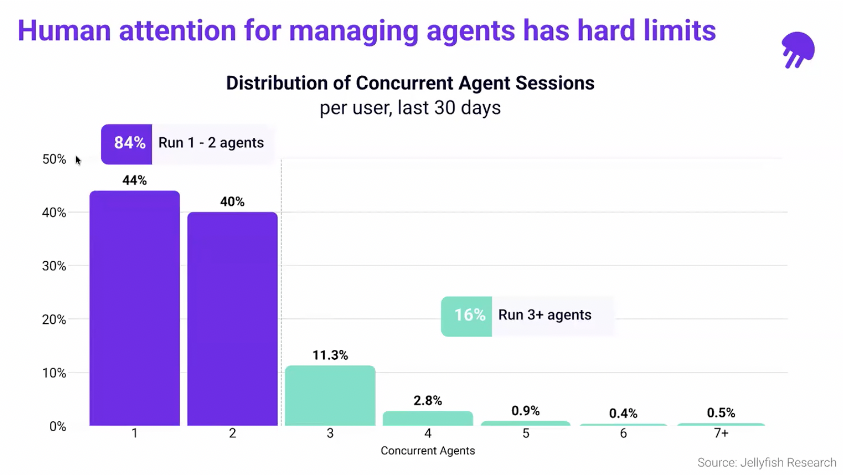
With interactive workflows, human attention throttles how much developers can do. Even when AI is writing almost all the code, most people can only manage and interactively prompt one or two agents at a time. Human attention stops being a limiting factor when you can give an agent a complete task to work on autonomously. But getting to that point requires changes to the system and infrastructure investments that will allow you to break through the “agentic barrier.”
Diminishing returns
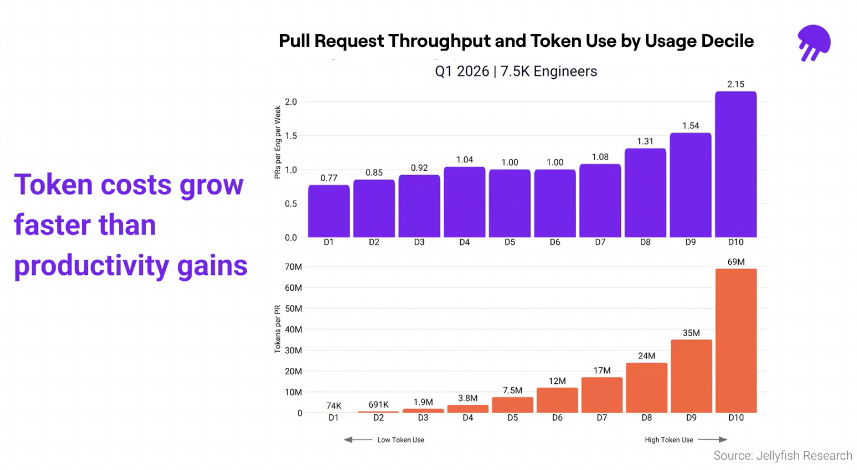
Highly autonomous workflows get pretty expensive pretty fast. But as organizations consume more and more tokens, they see diminishing returns. Developers in the 90th percentile use around 10X more tokens than the median, but they see only a 2X difference in the amount of merged code.
The economic impact of “tokenmaxxing” is clear when we look at individual usage. While the median developer spends $50 to $100 a month on AI tokens, the top 5% are accumulating costs of $5,000 and over. That level of spending affects the bottom line, and it’s the reason why organizations are starting to ask engineers to show their receipts.
Not everything moves the needle
AI agents don’t appear to be causing quality issues at scale. When we plot bugs, escape defects, and revert rate against a company’s level of AI adoption, we see no dramatic difference between low and high adopters.
This mostly comes down to people being good stewards of AI. Companies want to look after their own interests, and they worry about what’s good for their customers and the business. Instead of pointing AI at dangerous things, they use it on their bug backlog or prototyping – work that feels safer but doesn’t move the needle in the short term.
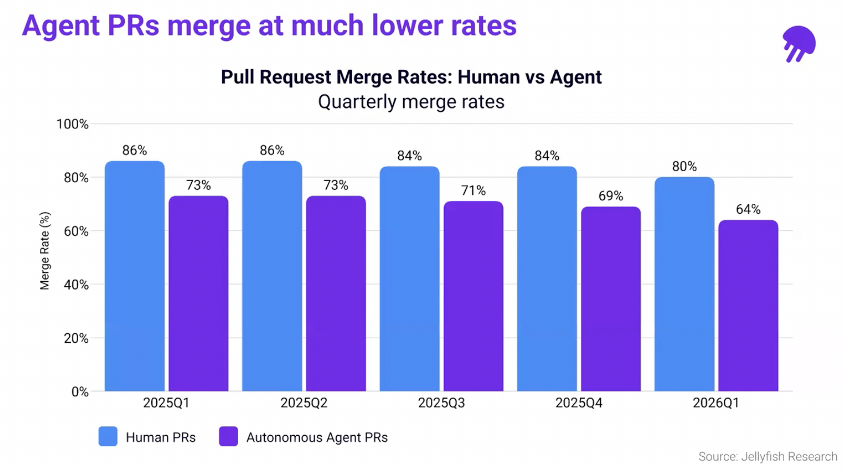
We’re also seeing that agentic code isn’t merged at the same rate as human code. Maybe an agentic workflow triggers proactive work that never makes it to the finish line, or developers repeatedly author multiple versions of the same thing. The bottom line is that organizations are spending tokens on work that isn’t making it out the door. To see a return on AI investment, you need to make sure token consumption is leading to a better product rather than generating waste.
How to close the ROI gap
Here are five recommendations to help engineering leaders to power through the headwinds and start improving ROI.
1. Teach your agents
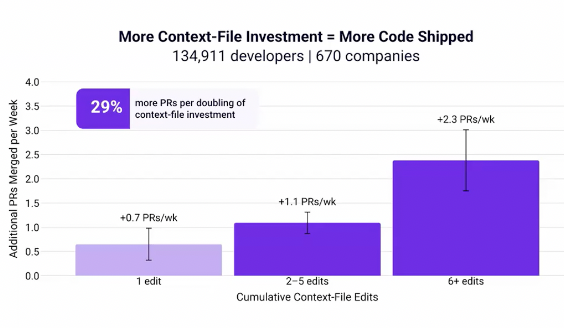
Investing in context and skills pays measurable dividends. Jellyfish data shows that every doubling of context-file investment gives you 29% more additional throughput on top of any other gains.
2. Enable autonomy
Some gains remain out of reach until you get to the upper echelons of autonomous agent workflows. To make it to the 90th percentile, you need to invest in a dedicated, coordinated motion that allows you to break through the barriers.
3. Optimize for the middle
Getting more of the organization from low levels of agentic workflows to the 80th or 90th percentile is more important than pushing a small group of developers towards extreme use. By optimizing for the middle of the curve, you can move the needle without breaking the bank.
4. Focus on bottlenecks
You can’t improve ROI unless you understand where your losses and bottlenecks lie. Is it the review process? Is agent-written code dying on the vine? Are developers pointing AI at things that don’t really matter? Instead of using AI on anything and everything, you need to figure out what actually moves the needle and improves business outcomes.
5. Measure outcomes, not just activity
As an industry, we’ve been thinking about how to make coding faster for decades. Now that coding is as fast as it needs to be, it’s time to focus on engineering outcomes. If you’re not looking at what ultimately gets shipped to customers, you might think the organization is making more progress than it actually is. You need to measure both the raw productivity gains and the downstream impact of those gains.
You can watch the full PlatformCon recording here. To read more about the impact of AI on the SDLC, check out the latest AI engineering trends from Jellyfish Research.
About the author

Nicholas Arcolano, Ph.D. is Head of Research at Jellyfish where he leads Jellyfish Research, a multidisciplinary department that focuses on new product concepts, advanced ML and AI algorithms, and analytics and data science support across the company.
About the author

Nikolas Albarran is a Product Researcher at Jellyfish.