This article is based on Jellyfish Head of Product Krishna Kannan’s session for the world’s biggest platform engineering conference, PlatformCon 2026.
After a period of steady but uneven growth, AI coding tool use has essentially reached full capacity with around 90% of software companies now using AI tools.
But if we look at how much code is written using AI, the story starts to change. Only a quarter of companies use AI to write the majority of their code, while the median company generates just 30% of its total code with AI.
It’s a puzzling situation. Adoption appears to be a solved problem, but impact still has a long way to go. Everyone is using AI in some shape or form, yet the outcomes vary from organization to organization and from engineer to engineer.
So what’s causing impact to lag behind adoption, and why are some organizations seeing major gains while others barely feel the impact? To shine a light on what’s happening and help platform teams position their organizations for success, we need to take a closer look at the data.
The Autonomous Agent Effect
Autonomous agent activity has grown dramatically over the last few months, and we see that reflected in rising token consumption. At the median company, AI users now consume an average of 32 million tokens per week, increasing to 95 million by the 75th percentile.
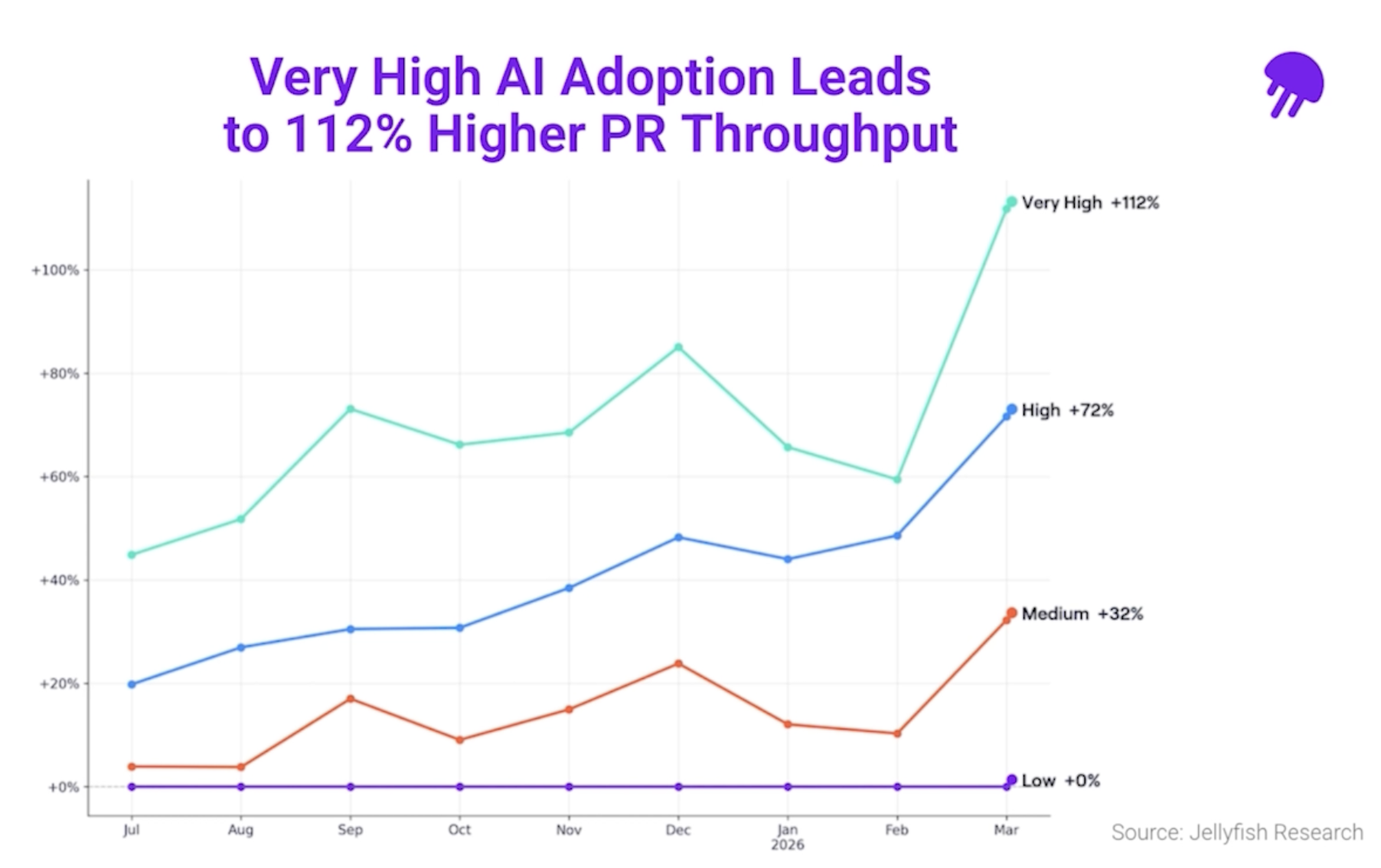
The companies that have adopted autonomous workflows are consuming the most tokens and seeing the biggest gains. According to Jellyfish research, very high AI use leads to a 112% increase in PR throughput compared to organizations with low adoption.
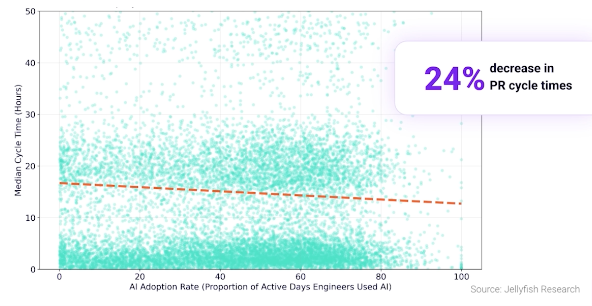
PR cycle time also improves as AI adoption rates rise, but not every company sees the same benefit. While AI use and cycle time are correlated, there’s substantial scatter with many companies falling above or below the trend line.
Despite the spike in agentic activity, adoption of autonomous AI agents remains relatively low. Even at the 90th percentile, companies are using autonomous agents for just 20% of their total PRs.
So while autonomous workflows help organizations tap into the biggest gains, they’re not the only thing separating the winners from the rest of the pack. Engineering leaders and platform teams need to dig into the data to find out what else is getting in the way of real progress.
Applying Jellyfish’s AI Impact Framework in the Real World
Jellyfish’s AI impact framework offers a good starting point for leaders trying to make sense of their engineering data. By focusing on adoption, productivity, and outcomes, the framework helps leaders understand what’s already working well and where impact is falling flat.
Let’s take a look at the different ways one Jellyfish customer used AI impact data to optimize their outcomes.
Adoption: Aligning the tool to the task
The company had very high AI adoption, but until recently, most engineers remained in the new user or casual user categories. When daily active use started to rise, the platform team wanted to understand what was driving the increase and use the insights to turn more people into power users.
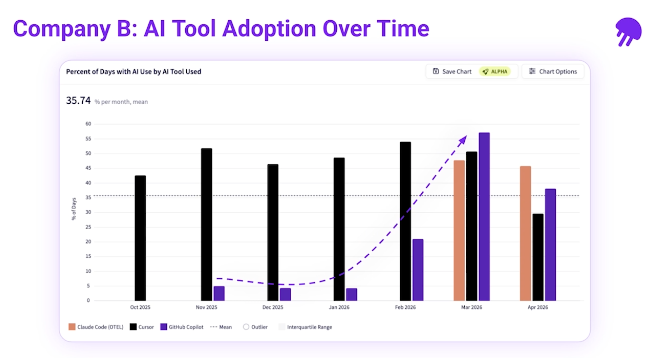
They segmented their data in Jellyfish to figure out what was still stopping some team members from engaging with the tools and identify opportunities for improvement. The data showed that while Cursor worked well for some parts of the organization, other teams were not seeing success with that particular coding tool.
The company decided to switch to a multi-tool approach, introducing Copilot and later Claude. When the platform team went back to the data, they found that the total use for each tool was fairly equal, but teams were seeing success by tailoring tool choice to different types of work.
Quality: A targeted approach
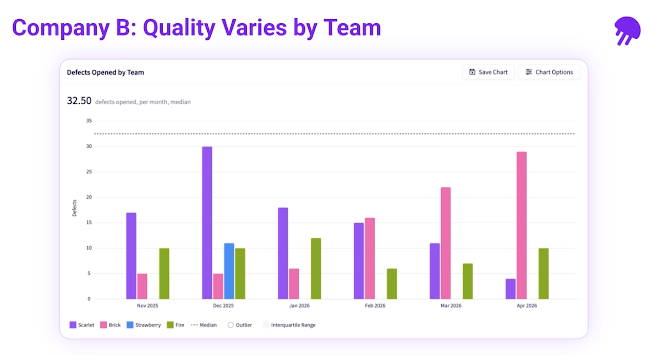
The company’s platform team was also concerned to see an increase in defects that correlated with AI use. Organizations that use AI do see a higher revert rate on their PRs compared to those with zero or low adoption. The difference in revert rates is small, and it probably doesn’t outweigh the benefits in terms of speed and production, but it does exist. Rather than jumping to the conclusion that AI was bad for code quality, this company again turned to the data.
Segmenting the data by team revealed a mixed message. While one team had seen a sharp increase in defects, another had actually seen defects decrease over the same period. Instead of implementing an organization-wide change that not everyone needed, the platform engineers could speak to that specific team and work with them to drive defects down again over time.
Outcomes: Prioritizing growth
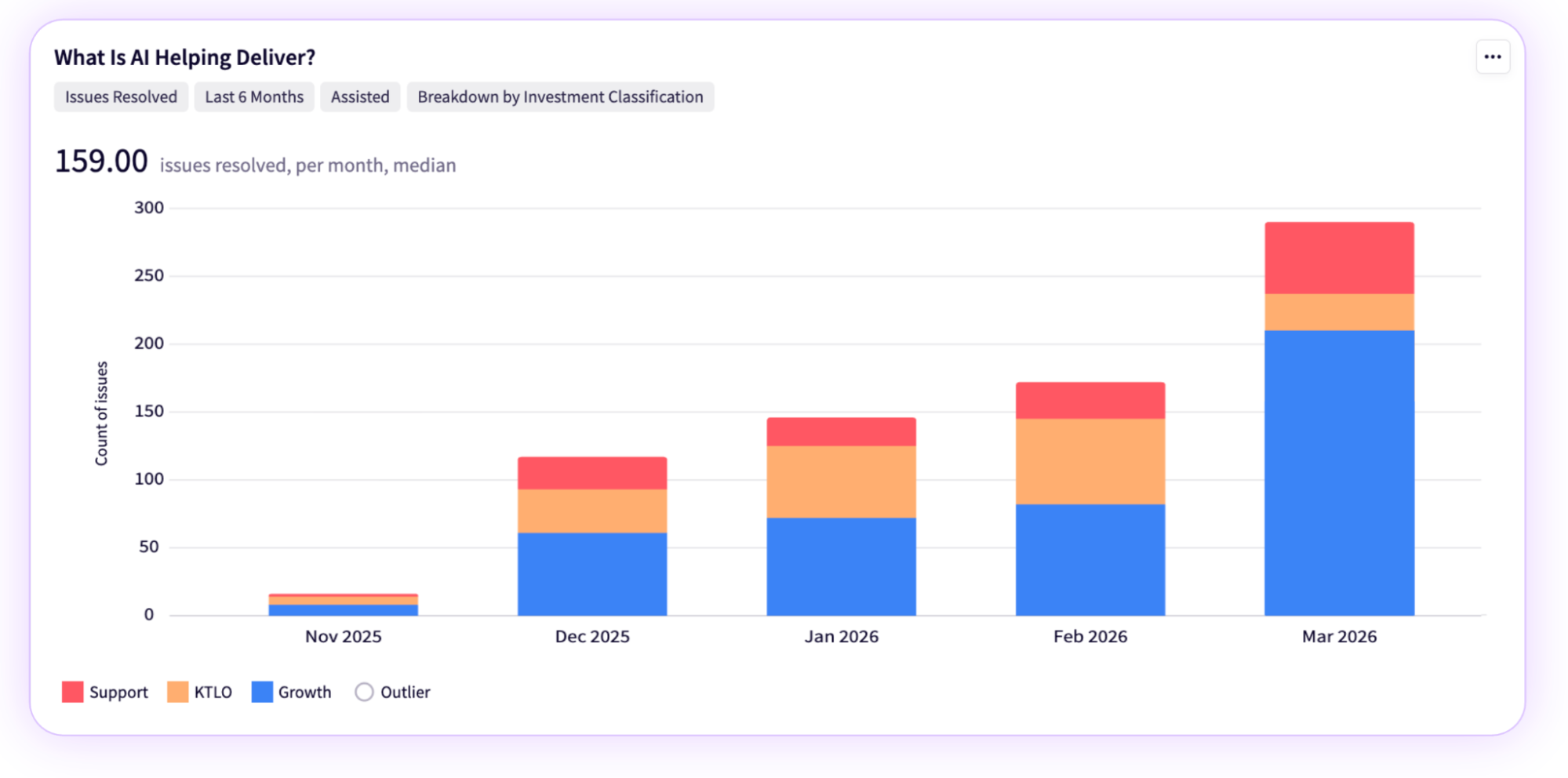
Lastly, to understand AI’s impact on the organization’s overall priorities, the platform team tracked the number of issues resolved in different categories. The data showed that around half of all work was already dedicated to growth, and they wanted to expand this even further with the help of AI.
As the organization adopted agentic solutions, they were able to see more PRs in the growth category, as seen in the data for the most recent reporting month.
Investigate Further
As shown in these three examples, engineering organizations need to be intentional about where and how they direct AI capacity. Engineering leaders and platform teams need to look at where AI can have the most leverage and how to best encourage broad and even adoption across their teams.
Any lack of progress most often comes down to AI directed at the wrong type of work rather than engineer intransigence or unwillingness to adopt new AI features and workflows. By slicing and analyzing the data, leaders and platform teams can find out what’s going on at a granular level and take precise action to get the organization moving.
You can watch the full recording of Krishna’s talk for PlatformCon 26 here. To find out how measuring AI impact with Jellyfish could benefit your organization, request a demo.
About the author

Krishna Kannan is Head of Product at Jellyfish, the leading Software Engineering Intelligence platform, where he drives product vision and strategy for over 500 customers. Previously, he held senior product leadership roles at Pluralsight and Smarterer, among others. Krishna resides in Greater Boston with his partner and two young children, learning as much from them as they do from him.