AI coding tools have moved from experimentation to strategic budget line item. In Q2 2026, frontier model providers and coding tool suppliers began rolling back subsidies and raising prices to reflect actual usage. Engineering leaders suddenly found themselves facing a new question from finance: Are we getting more out than we’re putting in?
Uber’s CTO publicly acknowledged burning through the company’s AI budget in just four months. Across the industry, engineering organizations are being asked to justify growing AI spend with measurable business outcomes.
At Jellyfish, we wanted to understand which teams are actually realizing value from AI-assisted development and which are simply increasing their costs. Last month, Jellyfish Research released its latest AI Engineering Trends report, analyzing engineering activity across 37 million pull requests, more than 1,000 companies, and 200,000 engineers.
The findings were clear: Teams that integrate AI deeply into their development workflow ship substantially more software while reducing delivery costs.
The Adoption Gap
The industry often talks about AI as if adoption were binary: teams either use AI or they don’t.
Reality is more nuanced. In April 2026, Steve Yegge described today’s engineering workforce as roughly:
- 20% fully agentic
- 60% AI-assisted
- 20% “hiding”
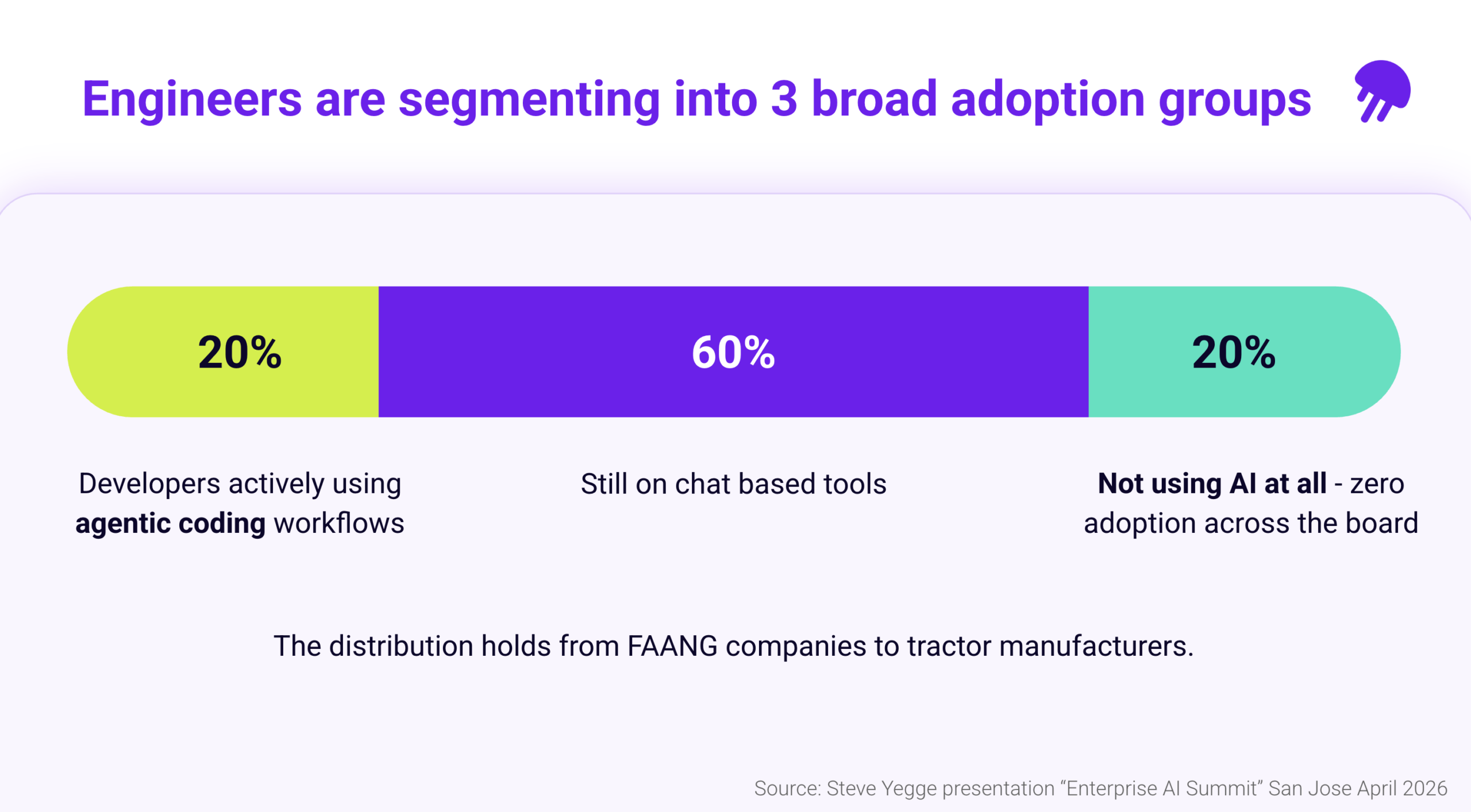
Whether the exact percentages are right is less important than the underlying observation: engineering organizations are becoming increasingly segmented by how deeply AI is integrated into day-to-day work.
The biggest performance differences aren’t emerging between companies that bought AI tools and those that didn’t. They’re emerging between teams that have made AI a default part of development and teams that still use it occasionally. That’s the distinction that matters.
Cursor Users Deliver More
To understand how adoption impacts outcomes, Jellyfish analyzed engineering output, delivery capacity, and cost efficiency across organizations using AI coding tools.
Cursor users stood out.
Compared to their peers, daily Cursor users demonstrated:
- 33% higher engineering output (10.3 PRs merged per month versus 7.0)
- 22% greater delivery capacity (8.0 issues shipped per month versus 6.3)
- 19% lower delivery cost ($1,071 per issue versus $1,304)
These aren’t marginal gains. They represent a meaningful structural advantage for teams that have successfully integrated Cursor into their development workflow.
As AI budgets come under greater scrutiny, these are the kinds of outcomes leadership teams are looking for – more software delivered at lower cost.
Adoption Depth Matters
But the most interesting finding wasn’t that Cursor users outperform their peers. It was how strongly outcomes correlate with adoption depth. Median Cursor users have AI assistance involved in roughly 95% of their pull requests. Across the broader industry, the average is closer to 61%.
That difference reflects more than tool preference. It reflects a fundamentally different way of working. Organizations using Cursor see productivity improvements ranging from roughly 15% to as high as 100%, depending on how consistently engineers incorporate AI into their workflow. At the high end, frequent users average 3.46 pull requests per week compared with 1.65 for baseline engineers – approximately double the output.
The New Metric: Intelligence Per Dollar
As AI spending increases, engineering leaders are being asked more and more to demonstrate what some are calling “intelligence per dollar”. But measuring AI impact remains difficult. For example, pull requests aren’t a perfect metric. And AI-assisted PRs are often larger and more complex than historical benchmarks. But PRs remain one of the few relatively stable measures available across organizations.
When viewed through that lens, the data suggests that teams with deeper AI adoption are generating more output per engineering dollar than their peers. And that’s becoming the metric that matters.
What Engineering Leaders Should Do Next
The takeaway from the benchmark is not that every organization should simply purchase Cursor licenses. It’s that organizations need visibility into adoption.
The teams realizing the largest gains aren’t necessarily those spending the most on AI. They’re the ones measuring usage, encouraging experimentation, and systematically moving engineers from occasional use toward AI-native workflows.
That’s why adoption has become a strategic metric. The competitive advantage now isn’t access to AI. It’s knowing whether your organization is actually using it effectively.
From our perspective, Cursor users are demonstrating what’s possible when AI becomes fully embedded in the software development lifecycle. The organizations that understand and accelerate that transition are likely to widen the productivity gap over the next several years.
–
Special thanks to Nik Albarran and Hugh Redford for their thoughtful feedback and contributions to this essay.
Data sourced from Jellyfish Engineering Intelligence and the Cursor Q1 2026 Benchmark. Study period: Q1 2026. More than 800 companies and 136,000 developers analyzed.
About the author

Billy Robins is Head of Partnerships at Jellyfish.