In this article
Jellyfish and Milestone AI help engineering organizations determine whether their AI investments are improving software development, though they serve different needs.
Jellyfish measures how the whole engineering organization operates. It links AI use to delivery performance, developer experience, and business priorities, so CTOs and VPs of Engineering can see what to improve and where to invest next.
Milestone AI started as a way to measure GenAI adoption and has grown into a wider platform. It now ties AI spend to features and initiatives, governs coding agents, and offers engineering analytics and custom reporting.
- Choose Jellyfish if you want to see how AI affects every part of engineering, then use that data to improve delivery, plan resources, and decide where the engineering budget should get allocated.
- Choose Milestone AI if your main goal is to measure the value of AI coding tools and keep autonomous agents under control across development teams.
Below, we look at where each platform is stronger, from AI adoption and agent governance to capacity planning and R&D financial reporting.
How do Jellyfish and Milestone AI Compare?
How do Jellyfish and Milestone AI Compare?
| Evaluation criteria | Jellyfish | Milestone AI | Ideal fit |
| AI adoption and effectiveness | Usage from nearly 20 AI tools, linked to delivery and the practices of strong teams | Line-level attribution of AI code, compared with non-AI work on speed and rewrites | Jellyfish, to scale the AI practices that work |
| AI spending and ROI | Token spend by tool and model, tied to initiatives, throughput, and team capacity | Spend by tool, team, and seat, attributed to features and initiatives, with budget limits | Depends. Jellyfish to connect AI spend with delivery and capacity Milestone AI to set budgets and limits |
| Agent ownership and governance | Agent contributions to PRs and velocity, measured next to human work | Agent registry with owners and access, plus workflow policies and approvals | Milestone AI, to register and govern autonomous agents |
| Engineering performance and code quality | DORA and custom metrics, stage-level timing, and sprint delivery analysis | AI and human cycle time, post-review changes, review depth, and DORA deployment metrics | Jellyfish, to improve delivery from planning to release |
| Developer experience | Developer surveys checked against DORA, SPACE, and system data, with a DevEx Index per team | Workload signals from Git and review data, with no published survey offering | Jellyfish, to hear from developers directly |
| Custom metrics and reporting | Plain-English custom metrics, Jellyfish Assistant and Agents, and editable executive reports | Vibe Metrics dashboards, Milestone Insights, and AI Chat | Jellyfish for consistent org-wide reporting and contextually-aware insights and recommendations |
| Software capitalization and financial reporting | Automated capitalization, R&D tax credit support, and SOC 1 Type II compliance | Feature-level costs, with no published capitalization or audit reports | Jellyfish, for R&D reporting to finance and auditors |
| Pricing | Three packages, quoted by seats and modules | Quote only, with AWS Marketplace contracts priced per active contributor | Depends on the scope you need |
What are the Key Differences Between Jellyfish and Milestone AI?
What are the Key Differences Between Jellyfish and Milestone AI?
AI Adoption and Effectiveness
Both platforms measure how engineers use AI coding tools. Jellyfish ties that use to team delivery and the practices worth scaling, while Milestone AI focuses on code attribution.
Jellyfish
Jellyfish AI Impact collects usage data from nearly 20 assistants, review agents, and autonomous agents, with no tags or process changes for developers. From there, teams get:
- Adoption trends by team and role, with a clear view of where AI use grows or drops off
- Before-and-after comparisons of each tool’s effect on PR cycle time and delivery speed
- Cohort and enablement insights that point to the habits of the strongest AI users and track how they spread
This way, teams can see which AI practices improve delivery and expand them.
Milestone AI
Milestone AI shows how much of a team’s code AI helped write. It matches Git commits with AI tool activity and labels a pull request as AI-impacted when at least 30% of its commits involve AI.
From there, teams can see if AI-impacted PRs move faster or slower than other work, and how often that code changes after review.
Best fit → Jellyfish helps organizations find the AI tools and habits that work and spread them across teams. Milestone AI offers more detail on the code AI writes.
AI Spending and ROI
Each platform connects AI costs to engineering outcomes, at a different level. Jellyfish measures AI’s effect on delivery and capacity across the organization, while Milestone AI traces spend back to features and seats.
Jellyfish
Jellyfish tracks AI token spend by tool, team, and model, and shows how PR throughput changes along with that spend. Features added in October 2026 connect AI costs to wider R&D decisions:
- Spend attribution links AI costs to the initiatives, deliverables, and roadmap areas they support.
- Capacity tracking shows how AI changes what each team can take on, adjusted for headcount.
- A total R&D cost view puts AI spend and people costs side by side.
Milestone AI
Milestone AI tracks AI spend by tool, model, team, and seat, and calculates what each AI-assisted pull request costs. It can also link spend to specific features and initiatives, and follow a feature’s cost from planning to post-release fixes.
For cost control, Milestone points out idle seats before license renewals and lets teams set budgets and spending limits by team, tool, model, or agent.
Best fit → Milestone AI offers cost control down to seats and team budgets. Jellyfish reveals the ROI on AI spend across engineering delivery and capacity.
Agent Ownership and Governance
Milestone AI is the stronger option here, with dedicated tools to register, monitor, and govern autonomous coding agents. Jellyfish treats agents as contributors and measures how their work affects delivery.
Jellyfish
Jellyfish’s Workflow Optimization shows how developers and agents work together, including how much of each pull request agents write and whether it merges.
The Metrics Explorer also puts human and autonomous agent activity in the same velocity metrics. Teams can then see which agent workflows speed up delivery and which slow it down.
Milestone AI
Milestone AI keeps a central registry of every coding agent in use, from tools like Cursor, Claude Code, Codex, and Devin to agents built in-house. For each agent, the registry records:
- Who owns it on the engineering and business side, and who handles escalations
- Which model and vendor it uses, and which repositories and systems it can access
- Its current status, from approved or monitored to restricted or retired
Milestone also follows how each agent performs over time, including how much of its code is accepted and kept, how much review it needs, and what each run costs.
Teams can then set rules for how agents work. Changes to security-sensitive code, for example, need senior approval before merge, and each agent can have its own spending limit.
Best fit → Milestone AI is the stronger choice for organizations whose top priority is control over autonomous agents. Jellyfish shows which agent workflows improve delivery and deserve wider use.
Engineering Performance and Code Quality
Jellyfish follows delivery across the full development lifecycle and traces slowdowns to their cause, while Milestone AI focuses more closely on AI-assisted changes.
Jellyfish
Jellyfish tracks DORA and custom engineering metrics for every team, along with how AI affects code health. It also helps teams find where delivery slows down:
- A stage-by-stage view of the development process shows if AI speeds up coding but leaves pull requests waiting in review.
- Sprint reviews explain what shipped, what slipped, and why, including causes like aging work or an overloaded team.
Milestone AI
Milestone AI measures cycle time for AI-assisted and agent work against traditional coding, phase by phase up to merge. To show if heavier AI use leads to more rework, it also tracks:
- Post-review change rate, or how often code changes after approval.
- Comment density and review cycles, to spot shallow reviews.
- DORA deployment frequency, lead time, and change failure rate.
Best fit → Jellyfish is the stronger choice for organizations that want to improve delivery as a whole, from sprint planning to release. Milestone AI gives a detailed view of how AI-assisted code performs through review and deployment.
Developer Experience
Jellyfish combines developer surveys with delivery metrics, since system data alone can’t always explain what slows engineers down. Milestone AI measures developer experience through code and review activity.
Jellyfish
Jellyfish sends research-backed surveys to developers and compares the answers with DORA, SPACE, and system metrics. A team can then check a complaint about slow reviews against its review time data.
Each team also receives a DevEx Index score it can compare with peers inside and outside the company. After a tool or process change, the next survey round shows if the experience improved.
Milestone AI
Milestone AI builds its metrics from Git history, pull requests, and reviews, which its product pages present as an alternative to “subjective surveys.”
Its Claude Code view, for example, tracks how much senior engineers’ time goes to reviews and fixes for agent work. Developer surveys aren’t part of its published feature set.
Best fit → For developer feedback tied to delivery metrics, Jellyfish offers a dedicated DevEx product. Milestone AI suits teams that prefer to gauge workload through Git and review data.
Custom Metrics and Reporting
Natural-language metrics and AI assistants come with both platforms. Jellyfish puts more focus on reports for planning and leadership reviews.
Jellyfish
Jellyfish gives teams three ways to analyze and share engineering data:
- Custom metrics that teams can define, adjust, and query in plain English
- An AI assistant that answers questions across delivery, planning, allocation, and AI data, and points out risks before anyone asks
- Report templates for AI adoption, impact, and tools, which teams can edit for leadership reviews
Team leads and executives can then work from the same metric definitions.
Milestone AI
Milestone AI offers similar natural-language reporting. Teams can describe a metric or dashboard in a prompt and get it built for them.
Automated insights point out when a metric moves away from the organization’s baseline and recommend an action, and an AI chat answers questions about AI spend, delivery, and agents.
Best fit → Milestone AI works well for teams that want each insight to come with evidence and a next step. Jellyfish suits organizations that need consistent reports, from team reviews to executive planning.
Software Capitalization and Financial Reporting
AI cost data shows engineering where money goes, while capitalization and tax credit reports have to satisfy accountants and auditors. Jellyfish supports both, and Milestone AI’s public materials focus on cost visibility.
Jellyfish
Jellyfish calculates what engineering work costs by measuring how much time went into each project and pricing it with payroll and roster data.
From there, it sorts those costs into capitalizable and non-capitalizable work, either automatically or through self-service, and reports the spend and headcount behind each piece of work. The same data supports R&D tax credit claims, and the reports are audit-ready, backed by SOC 1 Type II compliance.
Milestone AI
Milestone AI’s cost data goes down to the feature level, with engineer time, AI usage, model costs, review, and rework in one figure. Reports for capitalization and audits aren’t part of its published features.
Best fit → Jellyfish is a better match for organizations whose finance team reports R&D costs from engineering data. Milestone AI helps engineering see what each feature costs in AI and human effort.
How do Jellyfish and Milestone AI Compare in Terms of Pricing?
How do Jellyfish and Milestone AI Compare in Terms of Pricing?
Both vendors sell through sales teams, though they share different amounts of pricing information. Jellyfish publishes its packages and pricing model, while Milestone AI’s only public pricing detail comes from its AWS Marketplace listing.
Jellyfish Pricing
Jellyfish offers three packages, and each quote depends on the seat count and modules a company selects:
- AI Impact suits organizations that start with AI tools, with AI DevEx analysis, multi-tool evaluation, adoption trends, and token spend metrics.
- Developer Productivity builds on AI Impact for the wider engineering organization, with custom dashboards and AI-powered queries, DevEx surveys, industry benchmarks, and DORA, SPACE, and AI metrics.
- DevFinOps is the finance package, with investment allocations, software capitalization, R&D tax credit support, and SOC 1 Type II compliant reports.
A custom quote confirms the exact cost for each team’s seats and package.
Milestone AI Pricing
Milestone AI doesn’t publish plans or prices on its website, which directs buyers to book a demo. Its AWS Marketplace listing sells 12-month contracts priced by the number of active contributors, but it doesn’t show a per-contributor rate.
Buyers should confirm the price with Milestone, along with which products, such as AI Spend Hub or agent governance, the contract includes.
Note → Quotes are easier to compare once you know what the platform needs to handle. An organization focused only on AI investments will have a different scope than one that also manages delivery and R&D financial reporting in the same platform.
User Reviews and Customer Feedback
User Reviews and Customer Feedback
Jellyfish has a 4.5 out of 5 rating on G2 from 430 reviews. Milestone AI scores 5.0 from seven reviews, which is a positive start but a smaller base of feedback to judge from.
Jellyfish
A G2 user who tracks productivity across several teams says Jellyfish brings AI usage, Jira, and pull request data into the same reports:
“I use Jellyfish to track engineering productivity and delivery across teams. It gives me visibility into AI usage, Jira tickets, pull requests, and PR analytics through clear graphs and reports.”
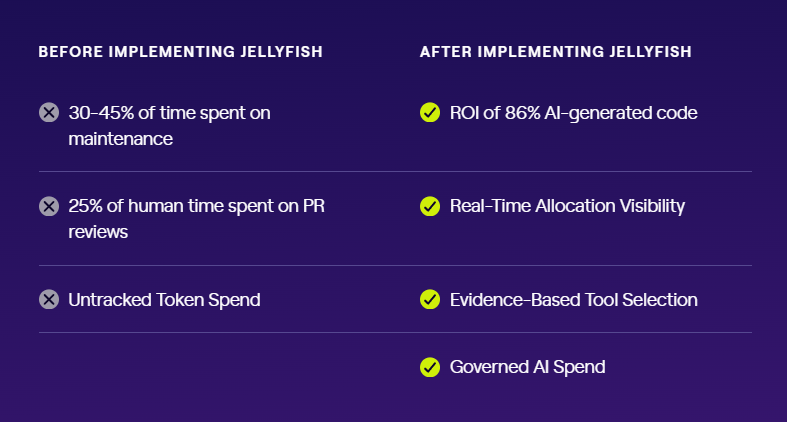
Loadsmart relies on Jellyfish for the same kind of decisions. Once AI coding tools started producing about 2.5 times more code, review delays grew to as much as 25% of delivery time. Jellyfish showed the team where work was stuck and measured the effect of an AI review tool, and review delays fell to 1–2% of delivery time.
Another user likes the visibility but finds the dashboards a little dense for quick QA lookups:
“While the dashboards provide strong visibility, they can sometimes feel a bit complex when trying to drill down quickly into QA-specific insights.”
Milestone AI
For one G2 user, Milestone AI’s main benefit is a single view of GenAI use across every team:
“The product analyzes Gen AI performance across all my teams and gives me an advantage with a top-level view of everything happening in my departments.”
Another user would like more guidance during the first weeks with the product:
“I wish the onboarding tutorials were a bit more interactive.”
Jellyfish vs. Milestone AI: Which Platform Helps You Make Better Engineering Decisions?
Jellyfish vs. Milestone AI: Which Platform Helps You Make Better Engineering Decisions?
Milestone AI helps organizations measure and manage their AI programs, from spend per feature to policies for autonomous agents. Jellyfish looks at engineering as a whole, so teams can see what AI changes across delivery, capacity, and developer experience, and decide what to improve next.
That wider view becomes more important as AI budgets grow. Jellyfish research across more than 878,000 developer-weeks found that AI spend per active user tripled in six months, while the work engineers focused on barely changed. More spend doesn’t automatically mean more roadmap work or faster delivery, so teams need to see what that spend changes.
- Milestone AI is a good fit if your priority is the cost and results of AI-assisted development. Its agent registry and governance policies also help teams that give autonomous agents more work and want closer control over how they operate.
- Jellyfish is the better fit if you need to understand how AI affects engineering performance across the organization and act on it. Its planning, DevEx, and allocation tools help teams set realistic plans and tie engineering work to business goals.
For engineering leaders who answer for delivery commitments and business results, that full view makes Jellyfish a stronger foundation for decision-making.
Request a demo to see Jellyfish with your own data, or walk through the product at your own pace.
FAQs
FAQs
Do Jellyfish and Milestone AI replace Jira or GitHub?
No. Both platforms read data from the tools teams already use, so work is still planned in Jira and code still ships through GitHub.
Jellyfish and Milestone AI each connect to GitHub, Bitbucket, Jira, and Linear, among others. Their functionality focuses on analysis of that activity.
How can project managers use Jellyfish and Milestone AI?
Both platforms let project managers track KPIs such as cycle time, throughput, and AI spend, and build custom metrics in plain language.
Jellyfish also forecasts delivery dates and team capacity, and it alerts teams to stalled work. Milestone AI shows what each feature costs in engineer time and AI usage.
About the author

Lauren is Senior Product Marketing Director at Jellyfish where she works closely with the product team to bring software engineering intelligence solutions to market. Prior to Jellyfish, Lauren served as Director of Product Marketing at Pluralsight.