In this article
Most engineering organizations are currently trapped in Cargo Cult DevOps. They have moved their servers to the cloud, renamed their sysadmins to DevOps engineers, and purchased a suite of AI tools—yet their release cycles are still measured in weeks, and their developers are still drowning in manual handoffs.
True DevOps adoption is not a software purchase; it is a fundamental restructuring of how your company builds and delivers value.
This guide outlines the strategic benefits of moving beyond surface-level changes toward a mature DevOps model, the cultural roadblocks that often derail progress, and the best practices for building a high-performing engineering floor.
Key Benefits of DevOps Adoption
Key Benefits of DevOps Adoption
The transition to a mature DevOps model provides several transformative benefits that impact both the engineering floor and the broader business:
- Accelerated time to market and delivery: Relying heavily on continuous integration and continuous delivery (CI/CD) pipelines shrinks the gap between a planned feature and its production release. Industry data from the 2025 State of DevOps report shows that elite performers using comprehensive CI/CD achieve 2,083x faster lead times than low-performing peers.
- Enhanced product quality and reliability: Shifting testing left allows teams to catch and fix bugs early in the development cycle. In modern environments that use progressive delivery patterns such as automated canaries and feature flags, high-performing DevOps teams experience change failure and rollback rates under 0.3%.
- The foundation for AI success: True DevOps maturity is the mandatory prerequisite for safely scaling artificial intelligence across the software development lifecycle. The 2026 Perforce State of DevOps Report reveals that 70% of organizations state DevOps maturity materially affects their AI success, allowing elite teams to seamlessly embed AI tools without introducing system instability.
- Cost optimization and operational efficiency: Automating repetitive manual processes shifts the team’s focus from reactive firefighting to infrastructure innovation. This smarter allocation of resources minimizes human error and reclaims engineering hours for high-value product development.
- Scalability and consistent governance: For large-scale enterprises, DevOps establishes a framework for consistent practices across multiple teams and geographic locations. This structured governance improves risk management, leading to fewer unplanned outages and drastically faster incident response times—with elite teams recovering 2,555x faster than their legacy counterparts.
5 Common Challenges in Adopting DevOps
5 Common Challenges in Adopting DevOps
Adopting DevOps requires transforming both a company’s technology stack and its internal mindset. As one Reddit user noted, “You can bring the horse to the water, but you cannot make it drink.” Most organizations face several deep-seated hurdles during this transition.
1. Resistance to Change and Siloed Mindsets
The most prominent hurdle is a refusal to abandon familiar, manual documentation in favor of automation. It is common for leadership to hear requests like, “…we don’t want Jenkins automation, we want a documented process developers can follow.” This stems from a misunderstanding that code-based pipelines are the documented process, codified in a language that both humans and machines can execute reliably.
2. Misunderstanding the Concept of DevOps
Many organizations believe that simply moving monolithic virtual machines to a cloud provider like AWS constitutes a DevOps transformation.
In reality, this often ends in a “lose/lose” scenario where companies pay twice as much for cloud hosting without gaining any agile advantages.
As one engineer put it, “Manual ‘automation’ is not automation… you’re not leveraging managed services, just doing everything by hand.”
3. The J-Curve of Productivity
Leaders often fail to anticipate “the dip.” When teams first adopt DevOps, productivity almost always drops as they weather the learning curve of new tools and broken legacy habits. Without executive air cover to protect teams during this phase, many organizations panic and revert to legacy processes before they can realize any gains.
4. Dealing with Legacy Systems
Older, monolithic architectures are often too heavy and rigid for continuous delivery pipelines. Attempting to “lift-and-shift” these systems to the cloud without modernizing the architecture often duplicates existing inefficiencies in a more expensive environment.
5. Severe Skills and Budget Shortages
There is a global lack of senior professionals who possess the necessary blend of development, operational, and security skills. Overcoming this requires a heavy upfront budget for training or headcount, but as one professional noted, “Lack of expertise is effectively budget.” If you don’t invest the time for employees to learn, you are choosing to stay in a state of high operational load.
Strategies for Effective DevOps Adoption
Strategies for Effective DevOps Adoption
Successful implementation requires a strategic blend of cultural transformation and phased scaling. To transition from legacy workflows to a streamlined model, organizations should follow these core strategies.
1. Foster a Collaborative DevOps Culture
The foundation of DevOps is a cultural shift that eliminates the “us vs. them” mentality between development and operations. This transition requires active leadership to build trust and shared ownership across the engineering floor.
- Provide executive air cover: Support your teams from the top down by giving them the protected time needed to focus on automation work rather than demanding endless feature delivery during the transition.
- Establish blameless retrospectives: Replace a culture of finger-pointing with an environment of open communication, allowing teams to treat failures as learning opportunities for continuous improvement.
- Conduct mandatory post-mortems: After every major incident, hold discussions focused strictly on systemic failures and pipeline gaps, never on individual human error.
2. Start Small and Scale Iteratively
Avoid attempting a massive, enterprise-wide rollout all at once. Successful transformations begin with targeted, manageable phases that build momentum and secure early wins.
- Launch a single pilot project: Dedicate a cross-functional team to a specific, manageable initiative to prove the value of your new CI/CD pipeline
- Target low-risk applications: Instead of trying to containerize a core monolithic billing platform on day one, start by migrating an internal API or a secondary microservice.
- Standardize successful templates: Once the initial pilot succeeds, document and standardize the DevOps processes so other business units can easily reuse them.
3. Implement Platform Engineering to Reduce Cognitive Load
To prevent developers from becoming overwhelmed by infrastructure complexity, organizations must move toward a platform engineering model that provides pre-built, self-service environments.
- Build internal developer portals: Provide centralized platforms that abstract away infrastructure complexities, preventing developers from having to configure Kubernetes from scratch every time.
- Treat your platform as a product: Assign a dedicated product manager to gather feedback from your developers (the “customers”) to ensure the portal is actually removing their deployment bottlenecks.
- Prevent reinventing the wheel: Centralize tooling and deployment templates so developers can focus their cognitive energy entirely on writing revenue-generating product code.
4. Integrate Security Early (DevSecOps)
As deployment speed increases, safety and governance must keep pace without requiring a final, manual security roadblock. Embed security practices directly into your pipeline using shift-left principles.
- Automate vulnerability scans: Integrate static application security testing (SAST) and dynamic scanning directly into the CI/CD pipeline so developers catch flaws while actively coding.
- Implement policy-as-code: Enforce security rules systematically to ensure that compliance is an automated, continuous process rather than a manual checklist.
- Block insecure pull requests instantly: Configure your pipeline to automatically reject any commit that contains hardcoded credentials or fails a security scan, pushing the fix back to the developer immediately.
5. Track DORA Metrics to Guide Progress
Engineering leaders must rely on objective data to measure the success of their adoption and pinpoint exactly where process bottlenecks are stalling time to market.
- Measure industry-standard metrics: Track your deployment frequency, lead time for changes, change failure rate, and mean time to recovery (MTTR) to benchmark your operational efficiency.
- Facilitate objective conversations: Use your performance data to remove emotion from evaluations, focusing discussions strictly on how to improve pipeline throughput and system stability.
- Automate your metric tracking: Do not force developers to manually log their deployment statuses. Use an engineering intelligence platform (like Jellyfish) to gather data directly from your existing version control and CI/CD tools.
Related reading → 22 Key DevOps Metrics for Tracking Development Success
6. Design a Scalable, Cloud-Native Toolchain
To fully modernize your development process, you need a consolidated ecosystem of DevOps tools rather than a fragmented collection of legacy apps. Engineering leaders must prioritize standardization so the entire organization can operate efficiently.
- Audit your automation tools: Before purchasing new software, map out your current delivery process to identify redundancies, allowing you to streamline your entire CI/CD toolchain.
- Migrate to cloud-native environments: To achieve faster time to market, move workloads to modern providers like Azure or AWS that natively support continuous deployment and automated testing.
- Adopt infrastructure as code (IaC): Replace manual server configurations with IaC methodologies, ensuring your production environment is completely reproducible and scalable.
7. Treat It as an Iterative Project
A successful DevOps implementation is not a weekend initiative. Implementing DevOps requires disciplined project management and a strategic roadmap. Treat this transition as a new way of working that must be rolled out in manageable phases.
- Upskill your team members: You cannot buy a DevOps culture; you must actively upskill your development teams and operations teams on core DevOps principles so they can rally around a common goal.
- Align initiatives with business value: Every new DevOps approach or process you introduce should map directly to a business outcome on your roadmap.
- Roll out changes in iterative phases: Use agile methodologies to implement new DevOps practices incrementally, proving the value of the software delivery improvements before scaling them across the entire company.
Drive Measurable Engineering Impact with Jellyfish
Drive Measurable Engineering Impact with Jellyfish
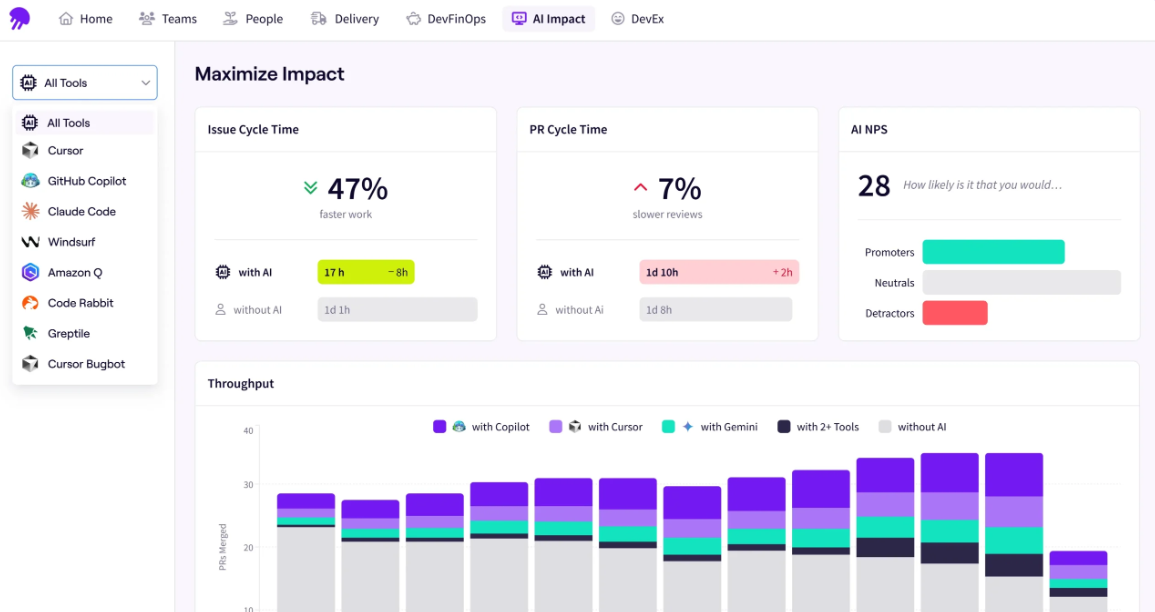
Adopting DevOps and AI tools accelerates delivery, but proving that these transformations actually drive business value requires normalizing massive amounts of fragmented SDLC data. Jellyfish, the Intelligence Platform for AI-Integrated Engineering, turns your developer tool data into clear, actionable productivity insights without changing how your teams already work.
- Standardize engineering metrics: Build a consistent measurement strategy grounded in DORA and SPACE frameworks to benchmark trends, uncover workflow friction, and elevate overall team performance.
- Optimize AI investments: Measure exactly how AI coding assistants and agents affect productivity, speed, and code quality so you can invest confidently in the tools that actually work.
- Align engineering effort: Gain complete visibility into how your resource allocation maps to strategic business priorities, allowing you to seamlessly rebalance work as goals shift.
- Increase delivery predictability: Leverage historical performance patterns to power accurate forecasts, trigger early risk alerts, and make confident delivery commitments to your stakeholders.
- Automate financial reporting: Eliminate manual time tracking for software capitalization and R&D tax credits by generating audit-ready financial reports directly from your engineering workflows.
“Jellyfish has transformed the way we work… team performance has increased by 30% and our delivery has become significantly more predictable. It has bridged the gap between engineering, product, and finance, allowing us to connect our technical efforts directly to business priorities.” — Jaime Vivas, SVP of Engineering at Siigo [Read Case Study]
Request a demo today to see how Jellyfish translates your engineering data into measurable business outcomes.
FAQs
FAQs
- What is the difference between DevOps and SRE? DevOps is a cultural philosophy focused on collaboration, while Site Reliability Engineering (SRE) is a specific implementation of DevOps that uses engineering to solve operations problems.
- How long does it take to see a return on DevOps adoption? Most organizations experience an initial productivity dip (the J-curve) but see significant labor savings and deployment speed gains within 6 to 12 months.
- Why is culture the biggest barrier to DevOps? Culture is the hardest to change because it requires breaking down silos, establishing shared ownership, and overcoming the human preference for manual “documented” processes.
- How does Platform Engineering help DevOps teams? Platform Engineering reduces developer cognitive load by providing self-service tools and standardized environments, preventing tool sprawl across the organization.
About the author

Lauren is Senior Product Marketing Director at Jellyfish where she works closely with the product team to bring software engineering intelligence solutions to market. Prior to Jellyfish, Lauren served as Director of Product Marketing at Pluralsight.