In this article
Building a high-performing engineering organization takes time. While every leader wants seamless collaboration, full automation, and continuous deployment, getting there requires a clear baseline.
This is where a DevOps maturity model becomes essential. By pinpointing exactly where your organization sits on the scale from manual operations to a fully automated pipeline, you can create a concrete roadmap to scale your software delivery.
What Is a DevOps Maturity Model?
What Is a DevOps Maturity Model?
A DevOps maturity model is a structured framework that engineering teams use to evaluate their current practices and build a realistic path forward. It breaks DevOps adoption into distinct stages, guiding teams from manual, ad-hoc processes to a highly optimized, automated state.
Assessing your position within this framework highlights exactly where you need to invest time—whether that means increasing automation, breaking down silos, or implementing better monitoring. Ultimately, the goal of the model is to give you an objective look at your current DevOps capabilities so you can eliminate bottlenecks, accelerate release cycles, and improve software quality.
The 5 Levels of DevOps Maturity
The 5 Levels of DevOps Maturity
The DevOps maturity model is a framework for organizations to understand and improve their DevOps practices, typically comprising five distinct levels. These maturity levels progress from chaotic, manual processes to highly efficient, automated workflows.
Each DevOps maturity level builds on the previous stage. Typically, the five DevOps maturity levels look like the following:
- Initial
- Managed
- Defined
- Measured
- Optimized
The number and naming of levels might vary, but generally, the methodology and idea behind each are the same.
1. Initial (Ad Hoc)
At this stage, organizations are just starting on their DevOps journeys. Teams will lack standardized or consistent development processes, won’t use any or much automation, and may struggle with siloed work. Overall, this environment contributes to infrequent and error-prone deployments.
2. Managed (Repeatable)
At this maturity level, organizations have introduced DevOps tools and practices that are becoming repeatable. Teams might use some automation, particularly in areas like continuous integration. Silos may still exist, but team members are likely starting to collaborate more frequently.
3. Defined (Continuous Delivery)
Defined DevOps operations have standardized delivery processes that are implemented across the organization. Automation is widespread, and teams adopt continuous delivery practices for more frequent and reliable deployments. Collaboration between software development and operations teams improves significantly at this stage.
4. Measured (Continuous Deployment)
Organizations with measured DevOps programs have reached the point where they’re measuring and analyzing their DevOps performance using key metrics. Continuous deployment is implemented with automated deployments to production. Teams emphasize data-driven decision-making and use feedback loops to drive continuous improvement.
5. Optimized (Continuous Operations)
This is the highest level of maturity, where DevOps practices are fully integrated into the organization’s culture. This looks like ingrained continuous improvement, extensive and self-service automation, and highly cross-functional teams. Highly mature DevOps organizations focus on optimizing their DevOps processes, infrastructure, and security.
Benefits of Using a DevOps Maturity Model
Benefits of Using a DevOps Maturity Model
DevOps maturity models help organizations evaluate their current capabilities, leading to faster software delivery and tighter collaboration between development and operations. Here is why you need one:
- Identifies areas for more efficient software delivery: A maturity model highlights exactly where you can streamline workflows and automate repetitive tasks. This accelerates your release cycles, reduces time-to-market, and minimizes deployment failures.
- Encourages higher quality software: By embedding continuous testing and real-time feedback into your processes, your DevOps team catches defects early. This leads to more stable applications and fewer production disruptions.
- Promotes a culture of collaboration, innovation, and improvement: Maturity models help break down silos between development, operations, and security. They drive data-backed decision-making and standardize repeatable processes.
- Facilitates DevSecOps: Mature organizations naturally integrate security into the software development lifecycle (SDLC). By shifting security left, you identify vulnerabilities early and embed compliance checks directly into your CI/CD pipelines, making security a shared responsibility rather than a bottleneck.
How to Determine DevOps Maturity
How to Determine DevOps Maturity
Teams measure DevOps maturity using a variety of metrics, tools, and frameworks that assess an organization’s practices, culture, and technology. It’s not just about metrics like deployment frequency; it’s also about how effectively tools are used and how well team members collaborate.
Here’s a breakdown of key ways to measure DevOps maturity.
Use DORA Metrics
DevOps Research and Assessment (DORA) metrics are likely the most well-known metrics for measuring DevOps performance. These include:
- Deployment Frequency: How often code is successfully released to production. This metric indicates the speed and agility of the deployment process.
- Lead Time for Changes: The time it takes for a code change to go from commit to production. This measures the efficiency of the software delivery pipeline.
- Change Failure Rate: The percentage of deployments that fail in production. This reflects the stability and reliability of the deployment process.
- Mean Time to Recovery (MTTR): How long it takes to restore service after a failure. This measures the resilience and recovery capabilities of the organization.
Assess DevOps Practices
Another way to assess the maturity of DevOps in your organization is to look at how well your organization implements key DevOps processes and best practices, such as automation and continuous improvement. Consider the efficacy of the following:
- Automation: Evaluate the extent to which processes are automated, including build, testing, deployment, and infrastructure provisioning.
- Continuous integration/Continuous delivery (CI/CD): Assess the implementation and effectiveness of CI/CD pipelines.
- Monitoring and logging: Evaluate the comprehensiveness of monitoring and logging practices, including the ability to detect and respond to issues proactively.
- Infrastructure as code (IaC): Assess the use of IaC to manage and provision infrastructure.
- Configuration management: Assess how well configuration changes are managed and version-controlled.
Consider Cultural and Organizational Factors
Don’t forget that DevOps isn’t just about which tools and processes you implement – there’s also the culture factor. In addition to quantitative measurements, consider leveraging surveys, one-on-ones, and team discussions to assess how well your team is adopting a DevOps culture. Look at factors such as:
- Collaboration: Evaluate the level and quality of collaboration between development, operations, and other teams.
- Communication: Assess the effectiveness of communication channels and processes.
- Feedback loops: Dig into the effectiveness of feedback loops for continuous improvement.
- Culture of experimentation and continuous learning: Assess the organization’s willingness to experiment and learn from failures.
Leverage Maturity Model Assessments
Run a DevOps maturity assessment to figure out where your organization falls in the maturity model spectrum. You can find DevOps maturity assessments and tools online, or you can build your own based on how your organization chooses to define each maturity level. Just remember to stick with the same maturity levels and definitions when you assess your organization so that teams don’t feel like they’re working toward a moving target.
DevOps Maturity Assessment: How to Evaluate Your Current Level and Pinpoint Areas for Improvement
DevOps Maturity Assessment: How to Evaluate Your Current Level and Pinpoint Areas for Improvement
A DevOps maturity assessment is crucial for understanding where your organization stands in its DevOps journey and for identifying areas that need improvement. Here’s a structured approach to conducting such an assessment.
1. Define Assessment Goals and Scope
First, clearly define what you want to achieve with the assessment. Are you aiming to improve deployment frequency, reduce lead time, enhance code quality, or something else?
Next, determine the scope of the assessment. Will it cover the entire organization or specific teams or projects? Establish clear objectives and success criteria.
2. Select a Maturity Model
Choose a suitable DevOps maturity model as a framework. Options include models based on DORA metrics, proprietary frameworks, or industry-standard models. Make sure the model you choose aligns with your organization’s goals and culture.
3. Gather Data
Collect data on DORA or any other metrics required from your chosen maturity model. You may use existing monitoring tools, CI/CD pipelines, and project management systems.
Also gather qualitative data through interviews with developers, operations engineers, and other stakeholders. Use surveys to assess team culture, communication, and collaboration.
Beyond metrics, consider examining existing documentation, standard operating procedures, and workflows to understand current practices. You may evaluate the use of automation tools, configuration management systems, and monitoring platforms.
4. Analyze the Data
Compare the gathered data against your chosen maturity model’s criteria. Look for strengths and weaknesses in your current DevOps practices and try to pinpoint areas where your organization falls short of desired maturity levels. Look for trends: Are there repeated failures, such as long lead times, in specific areas?
5. Create a Gap Analysis
Next, document the gaps between your current state and the desired maturity level. Prioritize actions to address the identified gaps based on their impact on business objectives. Develop a roadmap for addressing the gaps, outlining specific actions and timelines.
6. Develop an Improvement Plan
After your gap analysis, create a detailed plan for implementing the necessary changes. Assign responsibilities and establish clear ownership. Define measurable goals and track progress regularly. Consider incremental changes, or implementing changes in phases to minimize disruption.
7. Implement Changes and Monitor Progress
Execute the improvement plan and communicate changes to all stakeholders.
Regularly monitor key metrics and track progress against goals. Create feedback loops so teams can easily provide feedback on the changes.
You should adjust the plan as needed based on feedback and results.
How Can an Engineering Platform like Jellyfish Help?
How Can an Engineering Platform like Jellyfish Help?
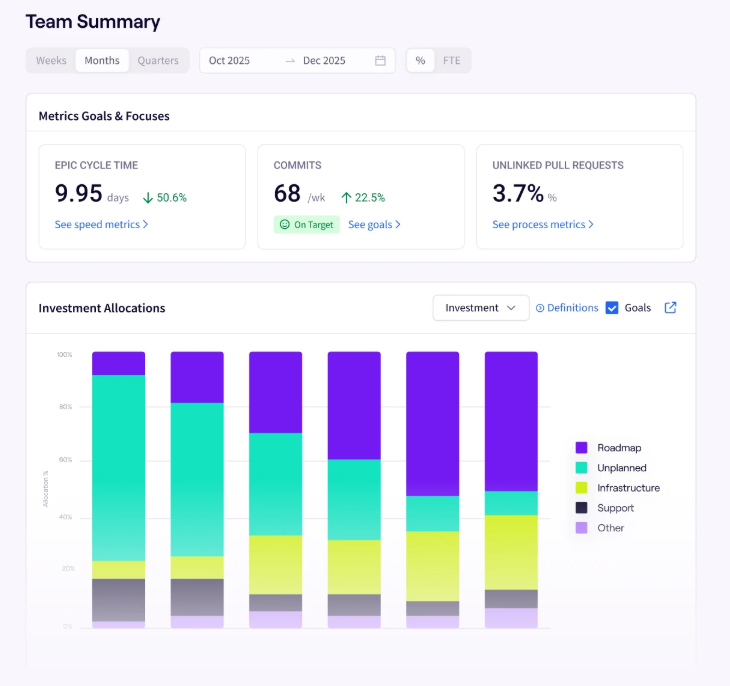 A maturity model tells you where you need to go, but you need actual data to get there. Jellyfish connects your existing tools to give you total visibility into your engineering operations. Here is how it accelerates your transformation:
- Automate your DORA metrics: Stop pulling manual reports. Jellyfish automatically tracks your deployment frequency, lead time, change failure rate, and MTTR so you always know exactly where you stand against industry benchmarks.
- Pinpoint pipeline bottlenecks: See exactly where code gets stuck. If a specific CI/CD stage or manual testing requirement is inflating your lead times, Jellyfish flags it so you can fix the root cause immediately.
- Align engineering effort with business goals: See exactly what your developers are actually working on. This ensures your teams are focused on strategic transformation initiatives rather than just fighting daily fires or keeping the lights on.
- Prove the ROI of your DevOps initiatives: When you invest in new automation tools or restructure your operations, Jellyfish gives you the concrete data to show leadership exactly how those changes improved velocity and reduced costs.
Climb the DevOps Maturity Ladder
The exact mix of ingredients needed for mature DevOps will vary by company. Don’t be afraid to start small, roll out phased changes, and iterate often on your journey to reach your full DevOps potential. If you’d like some help along the way, check out Jellyfish!
Get a Demo NowFAQs
FAQs
What is the ultimate business impact of reaching peak DevOps maturity?
At the highest level of maturity, the focus shifts entirely from internal operations to the external user experience. By eliminating deployment bottlenecks and guaranteeing system stability, your engineering teams consistently ship reliable, valuable features. This predictable velocity translates directly into higher customer satisfaction and a stronger competitive edge in the market.
How does a mature DevOps model handle system failures?
A highly optimized DevOps environment relies on deep observability and continuous monitoring to detect anomalies before they impact the end user. When an issue bypasses testing, automated incident response protocols and rapid rollback capabilities ensure the system recovers instantly, minimizing or eliminating downtime.
How do we scale our infrastructure without breaking existing systems?
Managing intricate system dependencies manually is a massive bottleneck for growing teams. By adopting core DevOps principles—like infrastructure as code and automated testing—you remove human error from configuration. This unlocks true scalability, allowing you to expand operations rapidly while still delivering high-quality software to your users.
About the author

Lauren is Senior Product Marketing Director at Jellyfish where she works closely with the product team to bring software engineering intelligence solutions to market. Prior to Jellyfish, Lauren served as Director of Product Marketing at Pluralsight.