In this article
Shipping code shouldn’t feel like a high-stakes gamble, yet for many engineering teams, every deployment carries a layer of anxiety. A minor misconfiguration can disrupt production environments, frustrate end-users, and drag developers into late-night war rooms. As organizations scale and systems grow more complex, the tension between moving fast and maintaining stability often becomes a major bottleneck for technical leaders.
Effective release management acts as the antidote to this chaos. It transforms deployment from a stressful, isolated event into a predictable, automated rhythm, allowing engineering leaders to ship high-quality software releases with minimal disruption.
What is Release Management?
What is Release Management?
At its core, release management is the process of planning, coordinating, and deploying software updates across different environments. It connects the entire software development lifecycle, ensuring that new features and bug fixes reach the end-user reliably and efficiently. However, the way engineering teams execute this process has drastically evolved.
Historically, ITIL dictated release management through strict schedules and heavy governance. Operations teams acted as gatekeepers, receiving finished code from developers and deciding when to push it live to protect system uptime. This siloed methodology created massive bottlenecks, slow feedback loops, and friction between departments.
Modern release management completely breaks down these silos. DevOps teams share accountability from the moment code is written to the second it hits production environments. By integrating developers directly into the delivery pipeline and leaning heavily on CI/CD automation, DevOps replaces infrequent, high-risk launches with an iterative, continuous delivery model. This shift allows software engineering teams to catch errors early, streamline workflows, and maintain high velocity without sacrificing stability.
Stages in DevOps Release Management
Stages in DevOps Release Management
Building a successful release cycle requires moving away from fragmented tasks and establishing a seamless, automated pipeline. Each phase must flow naturally into the next to ensure continuous improvement and fast delivery.
Planning and Scheduling
Every successful release starts with strict alignment between engineering and business stakeholders. This stage involves defining clear acceptance criteria, mapping out technical dependencies, and identifying the exact scope of the new functionality.
Agile methodologies guide this process, ensuring that the team understands exactly what is required to ship reliable releases before development even begins.
Recommended read → A Practical Guide to Agile Roadmap Planning
Continuous Integration and Testing
Once development is underway, engineers merge their code changes into a central repository multiple times a day using continuous integration. This practice triggers automated builds and rigorous quality assurance protocols.
By weaving unit tests, security checks, and regression testing directly into the CI/CD pipelines, teams catch defects immediately. This drastically reduces human error and prevents faulty code from advancing further down the delivery pipeline.
Deployment and Continuous Delivery
After the code passes all automated tests in a staging environment that mirrors production, it moves into the deployment phase. Continuous delivery ensures the software is always in a deployable state, while continuous deployment automates the actual release to production environments.
Whether rolling out a minor bug fix or major new features, deployment automation executes the release seamlessly, ensuring minimal disruption to the user experience.
Monitoring and Post-Release Analysis
The release management process does not end once the code is live. DevOps teams rely on real-time metrics, logs, and monitoring tools to track performance, system health, and end-user behavior. If critical anomalies bypass user acceptance testing and trigger alerts, automated rollback procedures instantly revert the system to a stable state.
Gathering this post-release data is crucial, as it drives continuous improvement and allows teams to optimize future release cycles.
DevOps Release Management Strategies
DevOps Release Management Strategies
Choosing the right deployment strategy depends entirely on your organization’s maturity, risk tolerance, and underlying architecture. Engineering leaders must select a DevOps framework that balances the need for speed with the necessity of system stability.
Release Windows
To control risk and minimize disruption, many organizations use release windows. This strategy designates specific timelines during which DevOps teams can deploy software updates to production environments. By scheduling deployments during off-peak hours, you limit the potential impact on end-users if an unexpected error occurs.
While this strategy is highly effective for reducing immediate risk, slow-cadence windows can sometimes create bottlenecks if multiple development squads are vying for limited deployment slots.
Agile Release Trains
For enterprise environments or complex applications with heavy dependencies, the release train methodology brings order to chaos. Pioneered by large software engineering companies like Microsoft, this strategy aligns multiple development teams on a single, shared release schedule.
If a team misses the “train,” their new features simply wait for the next scheduled cycle. This ensures that large-scale software releases with intertwined code changes are delivered safely and predictably, keeping all stakeholders aligned.
Continuous Release Availability
The ultimate goal for mature DevOps practices is continuous release availability. In this model, engineering teams have the autonomy to push code to production in real-time, 24/7. This strategy requires a highly optimized delivery pipeline, relying entirely on fully automated CI/CD pipelines, feature toggles, and self-recovering components. It eliminates scheduling constraints entirely, enabling the fastest possible delivery of value to end-users without compromising quality.
Release Blackout Periods
Sometimes, effective release management is about knowing when not to deploy. Release blackout periods are strict code freezes enforced during critical business events, such as a major holiday sales season or the final weeks of a fiscal year.
By pausing the deployment process for non-essential bug fixes and new functionality, operations teams safeguard the system from self-inflicted downtime when maintaining existing stability is the absolute top priority.
Release Management Best Practices
Release Management Best Practices
Implementing a strategy is only half the battle. To truly streamline the software development lifecycle, engineering leaders must enforce best practices that eliminate human error and promote continuous improvement across the delivery pipeline.
1. Define Strict Acceptance Criteria
A successful release cannot rely on subjective measures. Product owners, quality assurance managers, and engineering leaders must establish clear, objective acceptance criteria before any code is written.
By defining exactly what constitutes a deployable feature, teams ensure that the final software delivery meets precise business requirements. This makes the entire release management process more predictable and allows teams to accurately measure quality.
2. Enforce Staging Environment Parity
Discrepancies between your testing and production environments are a primary source of deployment failures. To catch defects early, you must maintain a staging environment that acts as a near-exact replica of production.
When your different environments mirror one another perfectly, user acceptance testing (UAT) and regression testing become infinitely more reliable. This ensures that code behaving correctly in staging will perform exactly the same way once it reaches the end-user.
3. Shift Quality Assurance Left through Automation
In a modern workflow, software testing cannot be an afterthought reserved for the very end of the delivery process. Shift-left testing brings quality assurance earlier into the software development lifecycle.
By integrating automated unit, functional, and security tests directly into your continuous integration tools, you establish immediate feedback loops. This catches bugs at the source, preventing costly delays right before a scheduled launch and ensuring high-quality outputs.
4. Transition to Immutable Infrastructure
Configuration drift is the enemy of reliable releases. Instead of modifying existing server configurations to accommodate new code changes, top engineering teams utilize immutable infrastructure. This means that once a component is created, it cannot be altered.
If an update is required, the team deploys an entirely new configuration. This approach drastically reduces human error, simplifies the rollback process in the event of a failed deployment, and guarantees consistent, highly stable environments.
5. Decouple Deployments from Releases Using Feature Flags
Traditionally, deploying code and releasing a feature were the exact same event. Modern DevOps teams separate the two. By utilizing feature flags and canary releases, engineering teams can safely deploy code to production environments while keeping the new functionality hidden from the majority of users.
This allows leaders to test performance with a small, controlled segment of the audience before executing a full rollout. If an issue arises, the feature can simply be toggled off without requiring a complex rollback or emergency bug fixes.
6. Track Core DORA Metrics to Measure Success
Effective release management requires leaders to track performance continuously to identify friction points within the delivery pipeline. Engineering organizations should benchmark their success against the four core DORA metrics:
By closely monitoring these data points, teams move away from gut feelings and use concrete evidence to optimize their workflows and increase delivery predictability.
Drive Predictable Releases with Jellyfish
Drive Predictable Releases with Jellyfish
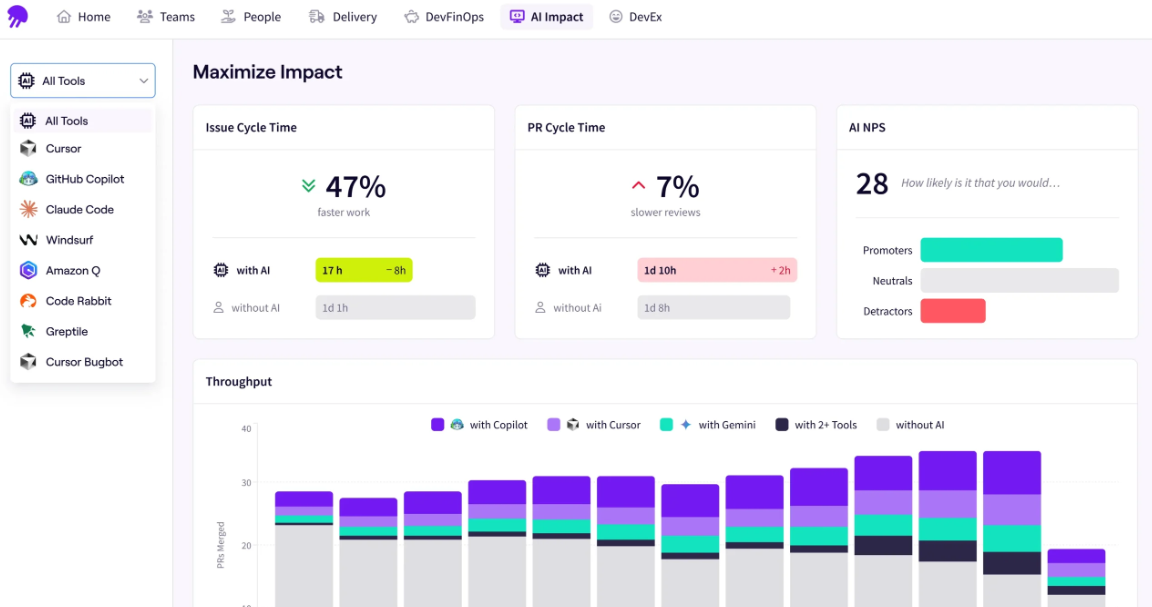
You can build the best CI/CD pipelines and deployment strategies in the world, but if you don’t actually know where your engineering effort is going, you are flying blind. Release management shouldn’t involve guessing games about capacity, resource allocation, or last-minute deployment surprises.
Jellyfish takes the fragmented data from your issue trackers, code repositories, and delivery tools and turns it into clear, actionable visibility for your engineering organization. It bridges the gap between engineering, product, and finance so you can prove exactly how your technical efforts drive real business impact.
With Jellyfish, you will:
- Increase delivery predictability: Plan with confidence using real capacity data, early risk alerts, and scenario modeling to keep your delivery process on track.
- Standardize engineering metrics: Build a consistent metrics strategy grounded in DORA and SPACE frameworks to benchmark trends and optimize your CI/CD pipelines.
- Align engineering effort: Ensure your engineering hours are actually being spent on your top business priorities, and quickly redirect your team’s focus when project scopes change.
- Leverage a predictive delivery system: Use historical performance patterns to power accurate forecasts, detect risks early, and make confident delivery commitments to stakeholders.
To learn more about how Jellyfish can help, request a demo now.
FAQs
FAQs
What is the difference between a software release and a deployment?
A software release refers to a versioned set of artifacts—such as source code files, libraries, or binary executables—packaged together for distribution. Deployment is the physical act of installing or activating those artifacts into a specific environment, like a staging or production server. Using feature flags allows teams to deploy code without immediately releasing the functionality to users.
How does release management impact data integrity and compliance?
Maintaining robust version control and automated backup policies throughout the release cycle protects critical data assets from corruption or loss during a deployment. Strict data integrity practices also ensure your deployment pipelines comply with major data governance regulations, such as GDPR or CCPA.
Who is responsible for release management in a DevOps model?
Unlike traditional ITIL frameworks, where a dedicated operations team acts as the gatekeeper, DevOps shares accountability. Software engineers, product owners, and operations professionals collaborate from the planning stage through continuous delivery, sharing responsibility for system uptime and code quality.
How do CI/CD pipelines improve the release process?
Continuous integration (CI) automates the building and testing of code every time an engineer commits a change. Continuous delivery (CD) automatically pushes that validated code to staging or production. Together, they eliminate manual handoffs, reduce human error, and drastically shorten the time it takes to deliver updates to end-users.
About the author

Lauren is Senior Product Marketing Director at Jellyfish where she works closely with the product team to bring software engineering intelligence solutions to market. Prior to Jellyfish, Lauren served as Director of Product Marketing at Pluralsight.