In this article
Many organizations treat DevOps as a generic buzzword for collaboration, but a true DevOps framework is the actual structural scaffolding that allows you to scale your software delivery.
It combines cultural models with a highly automated toolchain to eliminate silos between development and operations teams. By establishing a clear workflow and defining shared responsibility, a framework standardizes your entire software development lifecycle. This structured approach is what allows teams to streamline operations, embrace agile methodologies, and consistently deliver high-quality software to end users.
Popular DevOps Cultural Frameworks
Popular DevOps Cultural Frameworks
A framework fails if it only focuses on buying new DevOps tools. Engineering leaders rely on established cultural models to guide their development process and embed core DevOps principles into their organizations.
The CALMS framework
Coined by Jez Humble, CALMS serves as a foundational checklist to gauge an organization’s readiness for DevOps. It ensures you are building a balanced ecosystem that prioritizes continuous learning alongside technical execution.
- Culture: Moving away from blame and isolated silos toward shared responsibility between development teams and operations teams.
- Automation: Eliminating manual, repetitive tasks to streamline the software delivery process and reduce human error.
- Lean: Identifying and removing waste or bottlenecks across the entire software development lifecycle.
- Measurement: Tracking everything from the health of your deployment pipelines to the business impact of new features using concrete data.
- Sharing: Fostering open communication and collaboration so that both successes and failures become shared knowledge.
The Three Ways
Popularized by Gene Kim in The Phoenix Project, this framework defines the underlying principles of all DevOps patterns. It breaks the required cultural shift down into three distinct mechanisms:
- The First Way (Flow): Accelerating the delivery of work from development to operations to the end user. This requires limiting work-in-progress (WIP) and building highly efficient CI/CD pipelines to maximize throughput.
- The Second Way (Feedback): Creating fast, continuous feedback loops from right to left (operations back to development). This ensures that when a failure occurs in production environments, it is detected and resolved immediately.
- The Third Way (Continuous learning): Building a high-trust culture that encourages daily experimentation. It focuses on learning from failures and transforming local discoveries into global improvements across the organization.
The DORA framework
Developed by the DevOps Research and Assessment (DORA) team, this model is highly quantitative. It shifts the focus from abstract cultural goals to measurable outcomes, allowing leaders to benchmark their organization against industry standards using four critical metrics:
- Deployment frequency: How often your organization successfully deploys code to production.
- Lead time for changes: The exact amount of time it takes for a code commit to reach the end user.
- Change failure rate: The percentage of deployments that cause a failure in production requiring a rollback or hotfix.
- Mean time to recovery (MTTR): How quickly your team can restore service during an unplanned outage or incident.
The Technical Components of a DevOps Framework
The Technical Components of a DevOps Framework
Culture sets the direction, but architecture dictates your speed. A functional framework relies on a tightly integrated ecosystem of automation tools to manage the end-to-end development process.
- Version control and source code management: Platforms like GitHub, GitLab, and Bitbucket act as the single source of truth for your code changes. Using Git ensures total visibility across the team as they collaborate on the source code.
- CI/CD pipelines: Continuous integration and continuous delivery are the engine of your framework. CD tools like Jenkins automate the build process, execute automated testing (including integration testing), and handle continuous deployment to push new features into production environments
- Infrastructure as Code (IaC) and configuration management: Manual provisioning is a massive bottleneck. IaC tools like Ansible allow you to treat infrastructure management like software, automating environment setup to ensure consistency and speed.
- Containerization and microservices: Legacy monoliths create brittle architecture. Tools like Docker package applications into containers, removing underlying OS dependency When paired with Kubernetes for orchestration, this containerization unlocks massive scalability and ensures the software functions exactly the same across all environments.
- Continuous monitoring and observability: Implementing real-time monitoring via an API or open-source tool gives your teams the observability needed to detect and resolve incidents before they impact the customer.
How to Build and Implement Your DevOps Framework
How to Build and Implement Your DevOps Framework
You cannot simply buy a suite of tools and expect your development process to fix itself. Here are the key steps you need to take:
Establish Shared Responsibility
Before touching any code, you must break down the silos between your development and operations teams. Create cross-functional DevOps teams that share accountability for the entire software development lifecycle.
When the people writing the source code are also responsible for maintaining the production environments, you naturally eliminate the friction of handoffs.
Standardize Your Toolchain
Audit your existing ecosystem to eliminate redundant software. Standardize your version control on a single platform—like Git, GitHub, GitLab, or Bitbucket—so all code changes follow the exact same workflow.
A unified, agreed-upon toolchain is mandatory for building a smooth delivery process.
Automate Your Deployment Pipelines
Start by implementing continuous integration. Require developers to merge code daily, which triggers automated testing and integration testing to catch bugs immediately.
Once your CI is stable, build out your continuous delivery and continuous deployment capabilities to safely push new features into production.
Modernize Your Infrastructure Management
Transition away from manual server configuration, which acts as a massive bottleneck for scaling teams.
- Implement infrastructure as code (IaC) using tools like Ansible to automate provisioning.
- Adopt containerization with Docker and Kubernetes to ensure your applications have the scalability needed to handle new features without breaking complex dependencies.
Create Continuous Feedback Loops
A framework must be iterative to survive. Implement real-time observability tools to monitor system health and track your failure rate in production.
Use this data to feed information directly back to the developers, driving continuous improvement and ensuring the consistent delivery of high-quality software to your end users.
Optimize Your DevOps Framework with Jellyfish
Optimize Your DevOps Framework with Jellyfish
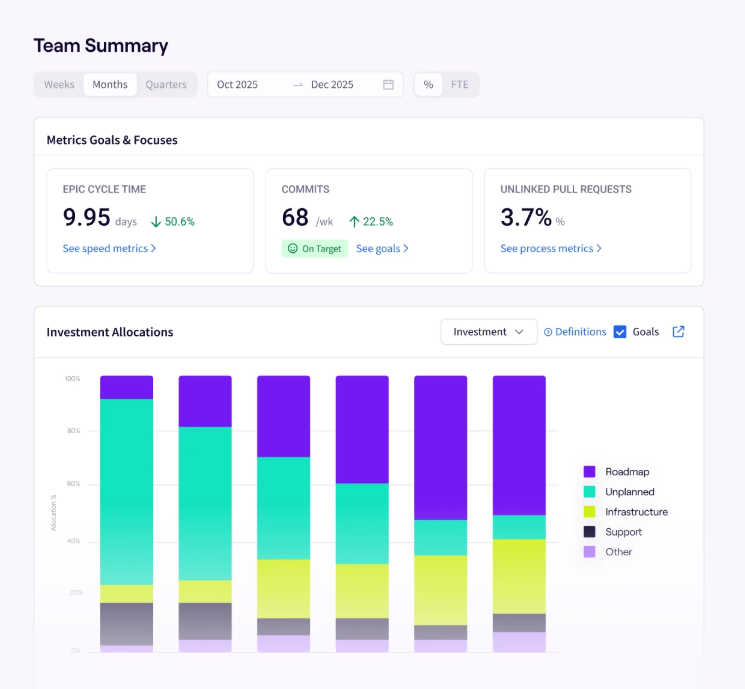
You can build the most advanced CI/CD toolchain in the world, but if you do not have visibility into how your engineering teams are actually working, your framework will stall. To truly optimize your software delivery process, you need intelligence layered over automation.
Jellyfish connects directly to your existing DevOps tools—from your Git repositories to your issue trackers—to provide total visibility into your engineering operations.
- Measure framework success: Automatically track your lead time to production, deployment frequency, and change failure rate to ensure your new DevOps practices are actually accelerating your workflow.
- Align effort with strategy: See exactly where your developers are spending their time. Ensure your teams are focused on building new features and driving continuous improvement, rather than just keeping the lights on.
- Identify pipeline bottlenecks: Combine system data with real-time analytics to pinpoint exactly where code gets stuck, allowing you to streamline the process before it impacts delivery.
Interested in learning more about Jellyfish? Tour the product or request a demo today!
About the author

Lauren is Senior Product Marketing Director at Jellyfish where she works closely with the product team to bring software engineering intelligence solutions to market. Prior to Jellyfish, Lauren served as Director of Product Marketing at Pluralsight.