In this article
Software development has never held one operating model for long. Waterfall gave way to Agile, and Agile expanded into DevOps as teams worked to shorten the distance between writing code and running it in production. AI is forcing the next rewrite.
Most teams have already started. Stack Overflow’s 2025 survey found 84% of developers using or planning to use AI tools in their development process, and 51% of professional developers using them daily.
Adding an AI coding assistant to the IDE is the easy part. The larger change happens when AI reaches the stages around the code, refining requirements, reviewing pull requests, writing tests, investigating defects, and supporting software in production.
That is what an AI-driven SDLC describes. Automation absorbs the repetitive work at each stage, and engineers spend more of their hours on context, judgment, and validation.
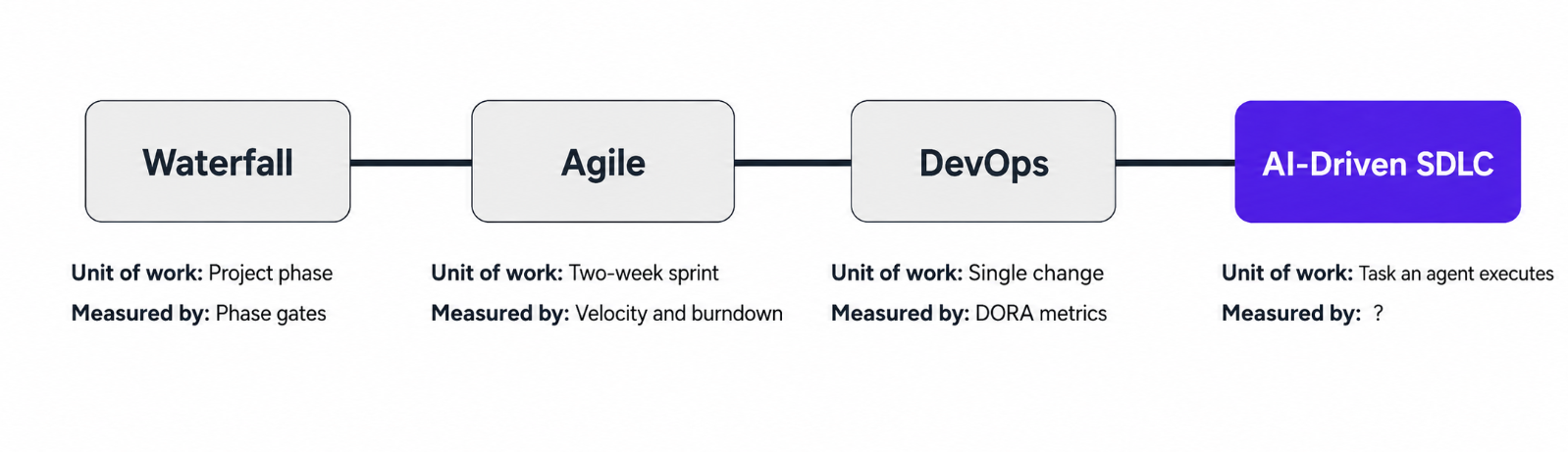
Each version of the lifecycle brought its own unit of work and its own way of keeping score. The AI-driven SDLC has the first and not yet the second.
This guide covers how each stage of the lifecycle changes, what the speed costs in review load and token spend, and how engineering leaders confirm the added velocity reached customers.
What Is the AI SDLC?
What Is the AI SDLC?
The AI SDLC is the software development lifecycle with AI applied at each stage, from requirements and design through coding, testing, deployment, and maintenance. Engineers keep authority over what gets built and what ships, and AI handles a growing share of the production work in between.
One clarification first. The term is used in two different ways:
- AI-driven SDLC, which means building software with AI. A team keeps the Agile or DevOps process it already has and applies AI tools across it, with GitHub Copilot, Cursor, or Claude Code writing code, agents reviewing pull requests, and models generating tests. The product at the end is ordinary software, produced faster and reviewed more heavily.
- AI-specific SDLC, which means building AI products. This is a different lifecycle altogether, usually described in seven phases and practiced as MLOps or LLMOps. Data collection, data preparation, model development, training, evaluation, deployment, and monitoring replace the familiar stages, and the work never really finishes, since a deployed model degrades as production data moves away from what it learned on.
This guide covers the first one. Most engineering organizations ship ordinary software and want to know how AI changes the lifecycle they already have.
How to know which one a source means → Check the vocabulary. Training data, model registries, evaluation sets, and data drift point to the AI-specific lifecycle. Pull requests, code review, sprints, and deployment frequency point to the one this guide covers.
Traditional SDLC vs. AI SDLC: What Changes?
Traditional SDLC vs. AI SDLC: What Changes?
The stages stay where they are. Requirements still precede design, code still precedes review, and nothing ships without passing a pipeline. What changes is the work inside each stage and the pace at which one stage hands off to the next.
Three changes carry most of the weight:
- Handoffs compress: A traditional lifecycle moves at the speed of human handoffs. A developer opens a pull request, the work waits in a queue until a reviewer picks it up, then waits again for QA. AI removes much of that waiting, since tests get written while the feature is still being built and a first-pass review arrives before a human opens the file.
- The work moves from producing to directing: Boilerplate, test scaffolding, config, and first-draft documentation move to the model. The engineer states intent, checks what comes back, and decides what to keep. That work carries more leverage per hour, and it consumes more attention per hour, which is a trade most teams underestimate when they plan capacity.
- The output stops being deterministic: Code a person writes behaves as written, and a bug in it traces back to a decision someone made and can explain. A model predicts the most likely correct code for a prompt, so the same request can produce different implementations, and the confident-looking ones fail as easily as the rough ones. Review changes character as a result, since a reviewer now checks whether the code does what the situation requires as well as whether it works.
Each difference changes something a team used to be able to assume. Here they are against the model they replaced:
| Traditional SDLC | AI SDLC | |
| Pace between stages | Set by human handoffs and queue time | Stages overlap, since work arrives before anyone asks for it |
| Where developer hours go | Producing the first draft | Directing, checking, and deciding what to keep |
| Nature of the output | Deterministic, and traceable to a decision someone made | Probabilistic, so the same request can produce different code |
Each stage absorbs these three changes differently. Requirements gain the most from speed, code review absorbs the most new load, and testing changes character entirely.
How AI maps to the traditional SDLC phases
How AI maps to the traditional SDLC phases
AI does not replace the SDLC so much as change what happens inside each stage. Requirements still need to be defined, software still needs to be designed and tested, and production still needs controlled deployment.
The difference is that AI can now take on part of the work in almost every phase:
| Stage | What AI does | What stays with a person |
| Requirements and planning | Drafts user stories, acceptance criteria, and edge cases from a short description, then asks about the details it was not given | Deciding what the product should do, and supplying business rules the model has no way to know |
| Design and architecture | Proposes data models, API contracts, and service boundaries, with the trade-offs listed for each option | Picking which option to build, and owning the result when the system grows around it |
| Coding | Writes implementations from a description, handles boilerplate and config, and completes code that follows existing patterns | Checking that the approach fits the wider system and deciding what to keep |
| Testing and QA | Generates unit and integration tests alongside the code, proposes edge cases, and reruns the suite at every change | Confirming the tests check what the requirements asked for, since a model tests what it built |
| Deployment and release | Produces infrastructure as code, pipeline configuration, and release notes, and watches deployments for anomalies | Approving what goes to production and when |
| Maintenance and operations | Explains unfamiliar services, traces defects through the codebase, and proposes fixes with the reasoning attached | Deciding which fix ships and whether the root cause was taken care of |
Key Benefits of Adopting an AI SDLC
Key Benefits of Adopting an AI SDLC
The case for an AI SDLC usually arrives as a speed argument, which undersells it. The larger changes show up in what engineers spend their day on, how quickly they can understand unfamiliar parts of the codebase, and how much routine maintenance work AI can absorb.
Here are the six main benefits:
- Delivery speeds up across the whole lifecycle: No single stage accounts for much on its own, and the savings compound as work moves through the sequence. Jellyfish found that 64% of engineering teams report at least a 25% increase in developer velocity from AI, and its platform data across 1,000+ companies puts top-quartile adopters at twice the pull request throughput of low adopters.
- Engineers spend more hours on roadmap work: Every engineering organization splits its week between new capabilities and the upkeep that keeps the existing system working. AI absorbs a meaningful share of the second, from boilerplate and config to migrations and test scaffolding. In the same survey, 60% of teams with very high AI adoption expect their roadmap time to increase, against 38% of low adopters.
- Test coverage stops being the first casualty: Writing tests after the fact costs an engineer time on work they have already finished in their head, which is why coverage slips first under pressure. Generating them alongside the implementation removes the delay and produces coverage for the awkward code paths that usually go untested.
- The first review pass is automated: An automated pass clears the mechanical problems, so the person reading the pull request spends their attention on whether the approach fits the system and whether the code respects rules a model has no way to know. Code review was near the bottom of AI use cases at 20% in 2025 and reached 49% in 2026, second only to writing code, according to the same Jellyfish survey.
- Documentation costs less to produce and maintain: Architecture notes, API references, and onboarding guides come out of the codebase instead of someone writing them by hand. Updating them after a change takes minutes, so they stay accurate longer than documentation usually does.
- Unfamiliar code is faster to understand: A model reads a service and explains what it does, how it is structured, and what depends on it. New engineers start contributing sooner, and any engineer can work in a codebase they did not write.
Challenges of the AI SDLC: Governance and Review Bottlenecks
Challenges of the AI SDLC: Governance and Review Bottlenecks
AI can speed up software delivery, but that extra output has to go somewhere. As teams generate more code, tests, documentation, and pull requests, the pressure moves downstream into review, governance, security, and cost control.
The main challenges fall into six categories:
- Code review becomes the new bottleneck: A team that doubles its pull request volume does not double its reviewers. Jellyfish research puts AI-assisted pull requests at roughly 18% larger than human-written ones, so each one takes longer to read on top of there being more of them. Stack Overflow found that 45% of developers spend longer debugging AI-generated code than they would writing it themselves.
- Vulnerabilities scale with output: Models learned from public code, and public code contains plenty of insecure patterns. Veracode tested more than 100 models across 80 coding tasks and found security vulnerabilities in 45% of the code they produced, with Java failing more than 70% of the time. More generated code means more of these to catch.
- Approvals get less careful over time: The problem is volume and repetition. AI-generated pull requests arrive constantly and look similar to each other, and attention drops accordingly. A team sees the same approval rate either way, which is why this is easy to miss until something ships that should not have.
- Technical debt accumulates faster than anyone tracks it: Models write new code more readily than they reuse existing code, so shared logic never forms. GitClear analyzed 623 million changes and found block duplication up 81% since 2023 and refactoring line moves down 70% against 2022 levels. A team pays for this later, when one fix has to be applied in six different places.
- Change failure rate goes the wrong way: DORA has found for two years running that AI adoption comes with more delivery instability. Its ROI model prices that at $344,000 in downtime for a change failure rate that moves from 5% to 6%. Pipelines and review gates sized for a slower lifecycle let more defects through when volume doubles.
- Nobody owns the code a model wrote: Accountability assumes an author who can explain their decisions. When a model writes the code and an engineer approves it, most organizations have not decided who answers for it in production, what they need to record about how it was produced, or which standards apply.
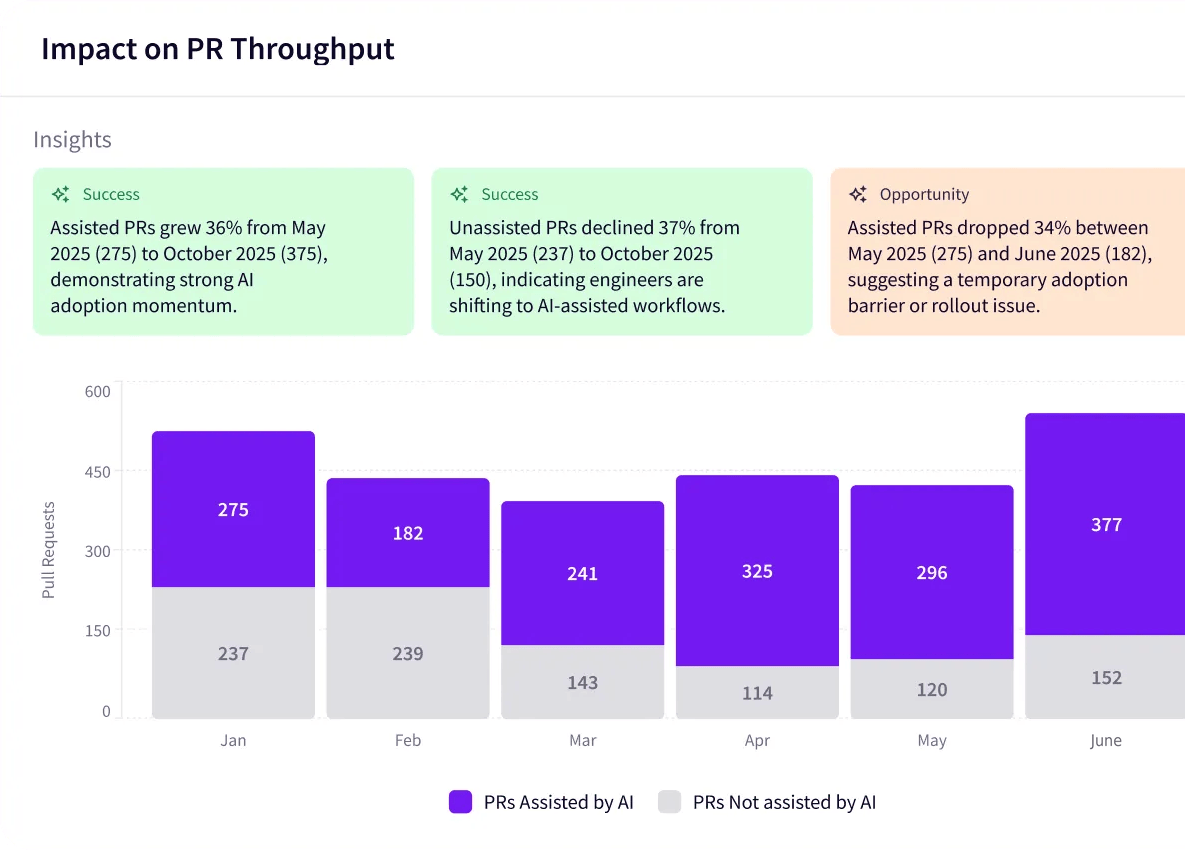
PRO TIP 💡: These problems build up as slow trends, never as a single incident, which is why teams find them late. Impact insights reads review time, rework, and change failure rate from your own SDLC data, so a review queue forming or rework climbing shows up while it is still small.
Measuring the Success and ROI of Your AI SDLC
Measuring the Success and ROI of Your AI SDLC
AI makes engineering activity very easy to inflate. More prompts, more generated code, and more accepted suggestions can all look impressive on a dashboard without making it clear whether software reached customers any faster.
Measurement has to start outside the AI tool for that reason. A vendor dashboard reports adoption and usage, since that is all a vendor can see from inside its own product. What a leader needs to know is what changed in the engineering system after AI entered it.
| What to measure | Why it matters |
| End-to-end cycle time | The only speed metric a customer experiences. Faster generation with the same delivery time means the savings never left engineering. |
| PR pickup and review time | Catches the most common failure, where code arrives faster and waits longer. A coding stage that shrinks while review time grows means the bottleneck moved downstream. |
| Change failure rate | Answers whether more changes reaching production also means more incidents. Speed that raises the failure rate costs more in downtime and hotfixes than it returns in throughput. |
| 30-day rework rate | Identifies code that passes review and fails later down the road. AI-generated code often looks correct enough to merge, so durability becomes measurable only after a few weeks in production. |
| Engineering allocation | Tracks where the freed hours went. Time saved counts as a gain only when it reaches roadmap commitments, and it disappears into low-priority work by default. |
| AI cost per outcome | Connects licenses and token spend to delivered work. Spend scales with usage automatically, so it needs reading against output and not as a monthly total. |
The rows work in pairs:
- Rows one and two separate coding speed from delivery speed. An assistant that saves a day and a half on implementation returns none of it to the customer when the pull request waits four days for a reviewer.
- Rows three and four show what the code cost after it merged. A team that ships more and then spends the difference on incidents and rewrites has delivered the same amount of software at a higher price.
- Rows five and six cover the economics. ROI needs the capacity a team gained and the token spend that it paid to get there, and most leaders can see only one of the two.
One caveat on timing → DORA models an early productivity dip it calls a J-curve, where output falls below pre-adoption levels while teams learn the tools, absorb the cost of verifying AI-generated code, and adapt pipelines built for less volume. A leader looking at those numbers in month three sees an investment that is not working. Record baseline numbers before anything changes, and set the evaluation window wide enough to cover it.
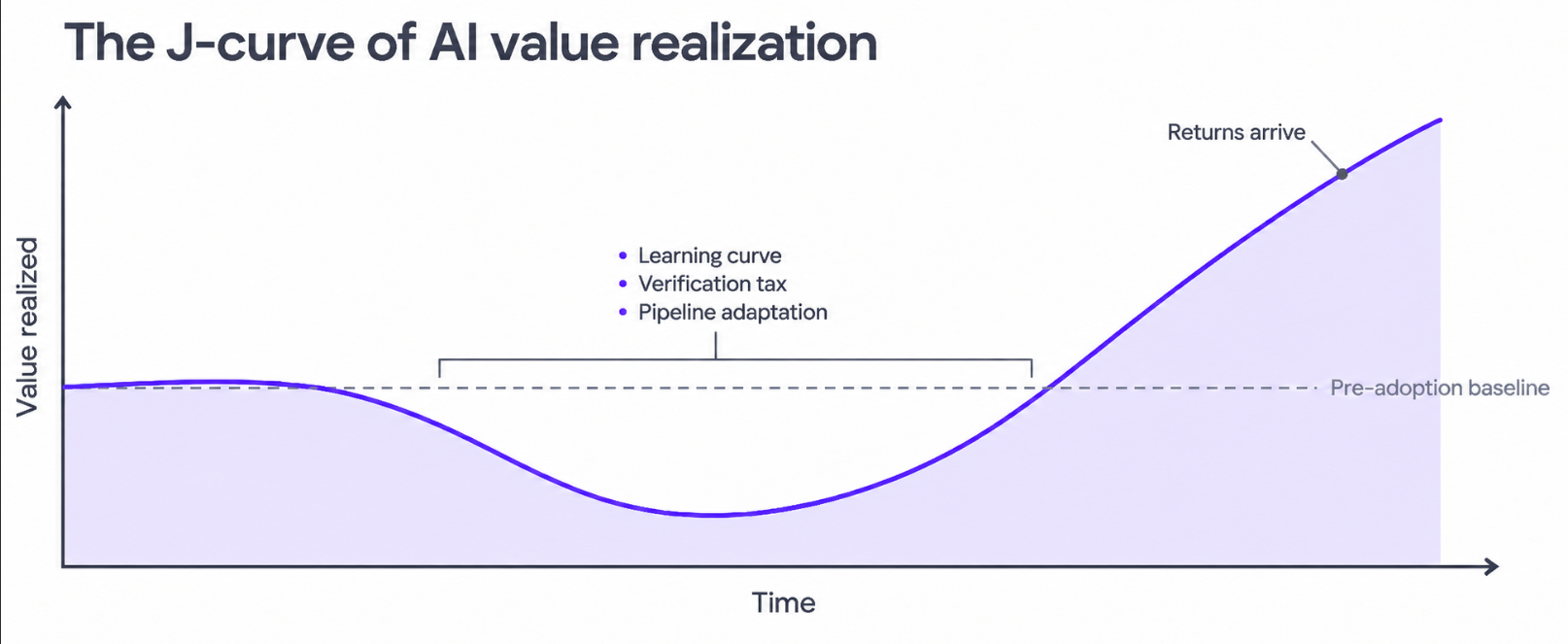
The J-curve of AI value realization, adapted from DORA’s ROI of AI-assisted Software Development report.
Measure the Impact of Your AI SDLC With Jellyfish
Measure the Impact of Your AI SDLC With Jellyfish
Every row in that table comes from a different system. Cycle time and rework are in version control, change failure rate is in deployment tooling, allocation is in planning tools, and cost is in vendor invoices. Pulling all four together takes work most teams never get around to.
Jellyfish is a software engineering intelligence platform built for this. It pulls delivery, quality, allocation, and cost data into one model and measures AI usage and spend against the work that reached production.
Its AI Impact capabilities cover the full measurement problem:
- Impact insights connect AI usage to throughput, quality, and delivery speed. The measurements come from a team’s own SDLC signals, which covers the first four rows of the table above. A pilot gets compared before and after on the same basis.
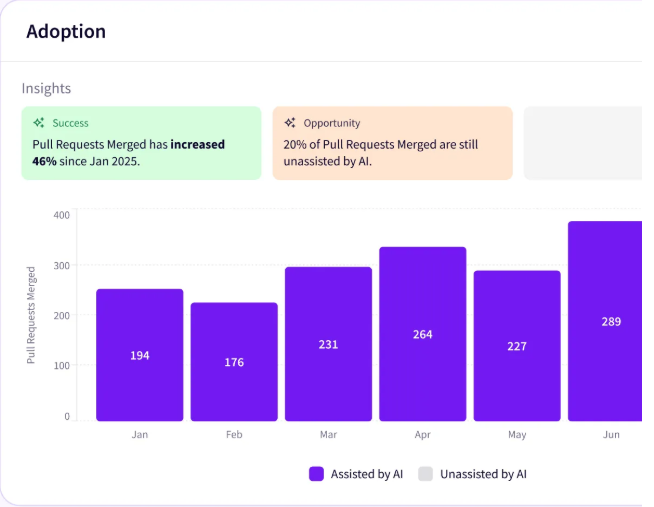
- Adoption insights show who uses AI, where, how, and with which tool. Jellyfish detects all of it from system signals, so the picture comes from behavior. Every other number in this section depends on getting this one right first.
- AI workflow insights show how work moves through a team’s process once AI is part of it. The view combines system signals, AI agent performance data, and developer feedback, covering what the tooling did alongside what the people absorbing it experienced. Review load and rework both appear here.
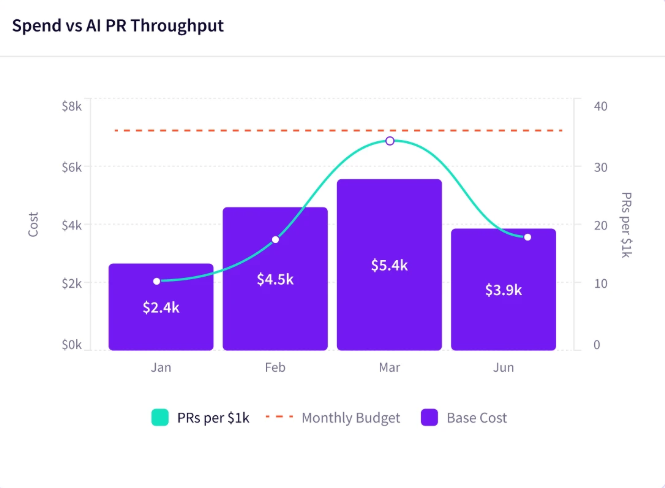
- AI token spend dashboard breaks usage and spend down by tool, team, and initiative. One monthly invoice is enough to approve a budget and too little to evaluate one. Attribution makes cost something a leader can read against delivered work.
- Multi-tool comparison settles the question most teams face at renewal, which is whether three AI tools are producing three tools’ worth of value. Jellyfish benchmarks assistants, agents, and new tools on one vendor-neutral model, so the comparison holds up when a finance team asks which subscriptions to keep.
- Auto report builder generates the AI report a leader has to present upward. It covers what is working, what is not, and where to invest next, built from the same delivery data as everything above. Most of the effort in AI reporting goes into assembly, and this removes it.
Whether a team applies AI to a few stages or rebuilds the lifecycle around it, the measurement question stays the same.
Book a demo to see what your own delivery data says about your AI investment.
FAQs
FAQs
What is the difference between AI-assisted and agentic coding?
AI-assisted coding keeps the developer in the driver’s seat. A person decides what to build, asks a large language model for help with a specific piece, and reviews what comes back.
Agentic coding hands over more of the sequence, so an agent plans the work, writes the code across several files, runs the tests, and opens a pull request without stopping at each step.
The difference matters for human oversight. Agentic AI produces a much larger unit of work before anyone looks at it, which concentrates all of the review into one place at the end. Teams that adopt autonomous systems in their lifecycle need to decide in advance which decisions an agent makes on its own and which ones wait for a person.
How do teams manage hallucinations and quality risks in an AI SDLC?
Generative AI predicts the most likely correct output for a request, so a model can produce code that looks reasonable and calls a library or API that does not exist.
These hallucinations carry the same confident tone as genuine work, which makes them hard to catch by reading alone.
Three controls handle most of it:
- Automated checks in the CI/CD pipelines. A hallucinated dependency fails at build time, so the pipeline catches what a reviewer misses.
- Wider quality assurance. A model that writes both the code and the tests verifies its own assumptions, so someone has to confirm the tests match the requirements.
- Explainability as a review standard. An engineer asks what a change does and why before approving it, and responsible AI in engineering comes down to that habit more than to any policy document.
Is spec-driven development the same as an AI SDLC?
No. Spec-driven development is a technique for giving an agent structured intent before it writes code, usually as requirements, a design, and a task list it works through one item at a time. Vibe coding works the opposite way, since a developer prompts loosely and the model fills the rest with whatever it considers reasonable.
An AI software development lifecycle is broader. It covers requirements gathering, design, coding, testing, deployment, and maintenance, plus who validates each stage and how the work gets measured.
Spec-driven development fits inside it. Structured intent makes AI coding tools reliable at the front end and keeps code refactoring within bounds an agent would otherwise exceed. Platform engineering usually owns this groundwork, since steering files and repository conventions serve every team using the tools.
About the author

Lauren is Senior Product Marketing Director at Jellyfish where she works closely with the product team to bring software engineering intelligence solutions to market. Prior to Jellyfish, Lauren served as Director of Product Marketing at Pluralsight.